

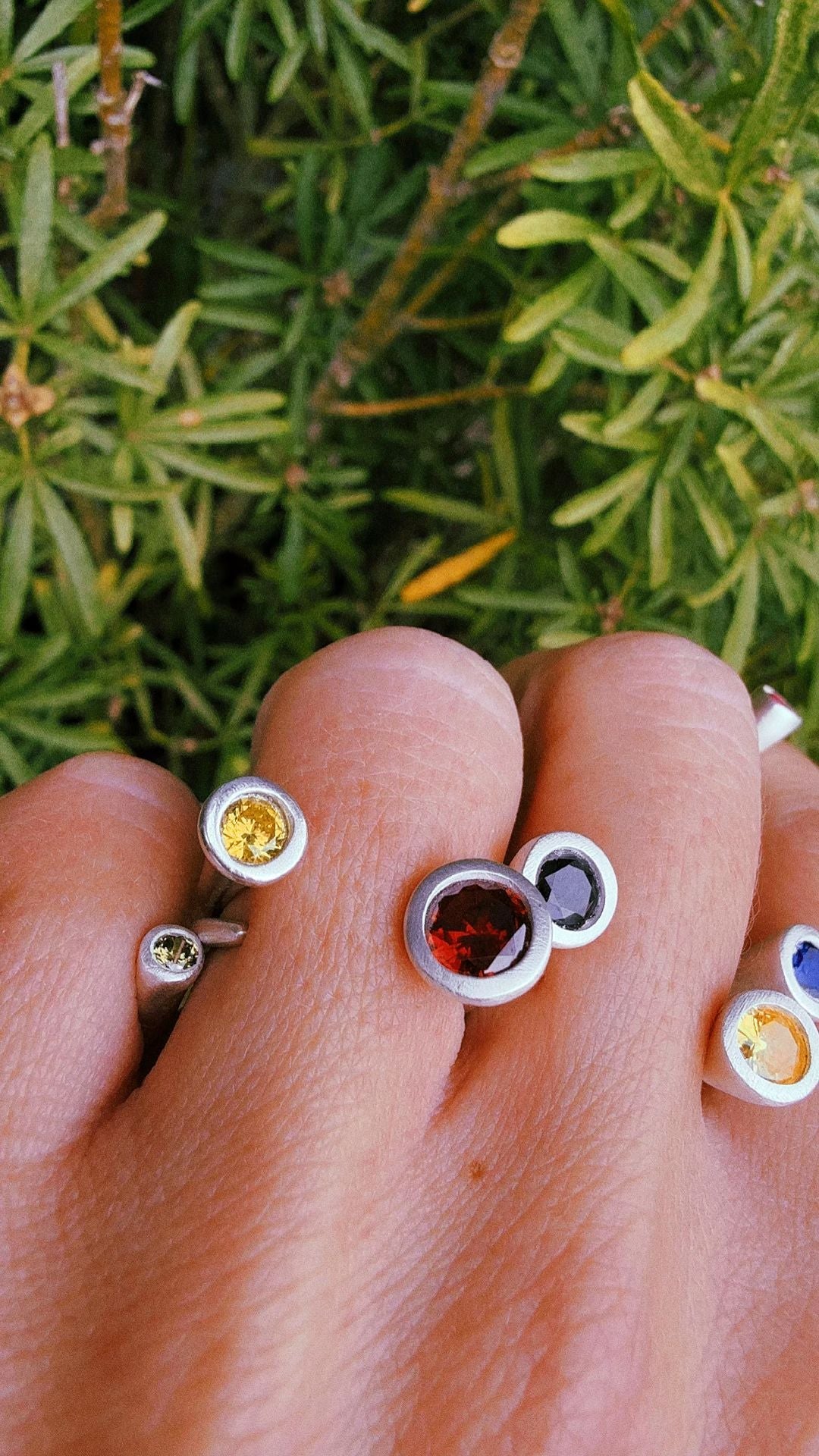
A jewelry tumbler is a small rotating barrel filled with steel shot that polishes and hardens metal while you do something else. It comes up constantly in metal clay discussions, usually framed as the thing you buy once you are serious. It is worth understanding what a tumbler actually does before deciding whether you need one, because for a lot of makers the honest answer is not yet.
What a jewelry tumbler does
The barrel holds your pieces, a handful of stainless steel shot in mixed shapes, water and a drop of burnishing soap. As the barrel turns, the shot tumbles over the surface of the metal thousands of times. It is not abrasive in the way sandpaper is. Nothing is being cut away. The shot is burnishing, which means it is pressing the surface smooth and compacting it.
That has two effects. The obvious one is shine: a piece that goes in matte comes out with an even, bright finish that is genuinely difficult to achieve by hand across a whole surface. The less obvious one matters more. Burnishing work-hardens the metal, and fine silver straight out of a firing is soft. For a ring or a bracelet that will be knocked about, that extra hardness is a real benefit.
What a tumbler will not fix
This is where expectations go wrong. A tumbler polishes what you give it. It does not remove scratches, it does not level an uneven surface, and it will not rescue a piece you did not sand properly.
If you put in a piece with visible file marks, you get out a piece with shiny visible file marks. All the surface preparation still has to happen first, by hand, in the usual order: refine the dry clay before firing, then brush and sand the fired piece through progressively finer grits. The tumbler is the last step, not a shortcut past the earlier ones.
It also cannot reach everywhere. Deep texture, tight recesses and the inside of a narrow bezel will hold shot rather than get polished by it. If your design is heavily textured, you may actually prefer the contrast of a hand-finished piece, where the raised areas are bright and the recesses stay darker.
Do you need one for silver clay?
Not to get started, no. A fired silver clay piece can be brought to a very good finish with a stainless steel brush and a little soapy water, followed by a polishing cloth or a burnisher on the edges you want brightest. That is how most first pieces are finished, and it works. The beginner walkthrough covers this finishing sequence.
A tumbler starts making sense in two situations. The first is volume. Hand-finishing one pendant is pleasant; hand-finishing fifteen of them for a market stall is not, and a tumbler will do a batch while you get on with something else. The second is durability. If you are making rings and bangles that get daily wear, the work-hardening is a genuine improvement rather than a cosmetic one.
If neither of those applies yet, spend the money on more clay. You will learn more from making five more pieces than from polishing your existing ones slightly faster.
If you do buy one
A small rotary tumbler is fine. The vibratory type is faster but noisier and generally aimed at larger production. Look for a barrel with a decent seal, because a leak makes a genuine mess, and buy mixed stainless steel shot rather than a single shape, since the pins, balls and diagonals each reach different parts of a piece.
Use enough water to cover the shot and the work, add a small amount of burnishing compound or a drop of washing-up liquid, and run it for around an hour for a first pass. Longer does not really mean shinier once the surface has burnished; it mostly means more noise. Rinse and dry the shot properly afterwards, because stainless steel shot left wet will eventually spot and then transfer that to your silver.
One caution worth knowing: if your piece has set stones, check they are secure and suitable before tumbling. Cubic zirconia handles it well, which is part of why it is the stone included in the silver clay starter kit, but anything glued rather than properly set should stay out of the barrel.
A tumbler is a good tool. It is just a finishing tool, and it belongs at the end of a process you have already got right by hand. Get comfortable with the clay first, and buy the tumbler when the batch sizes start to justify it.