

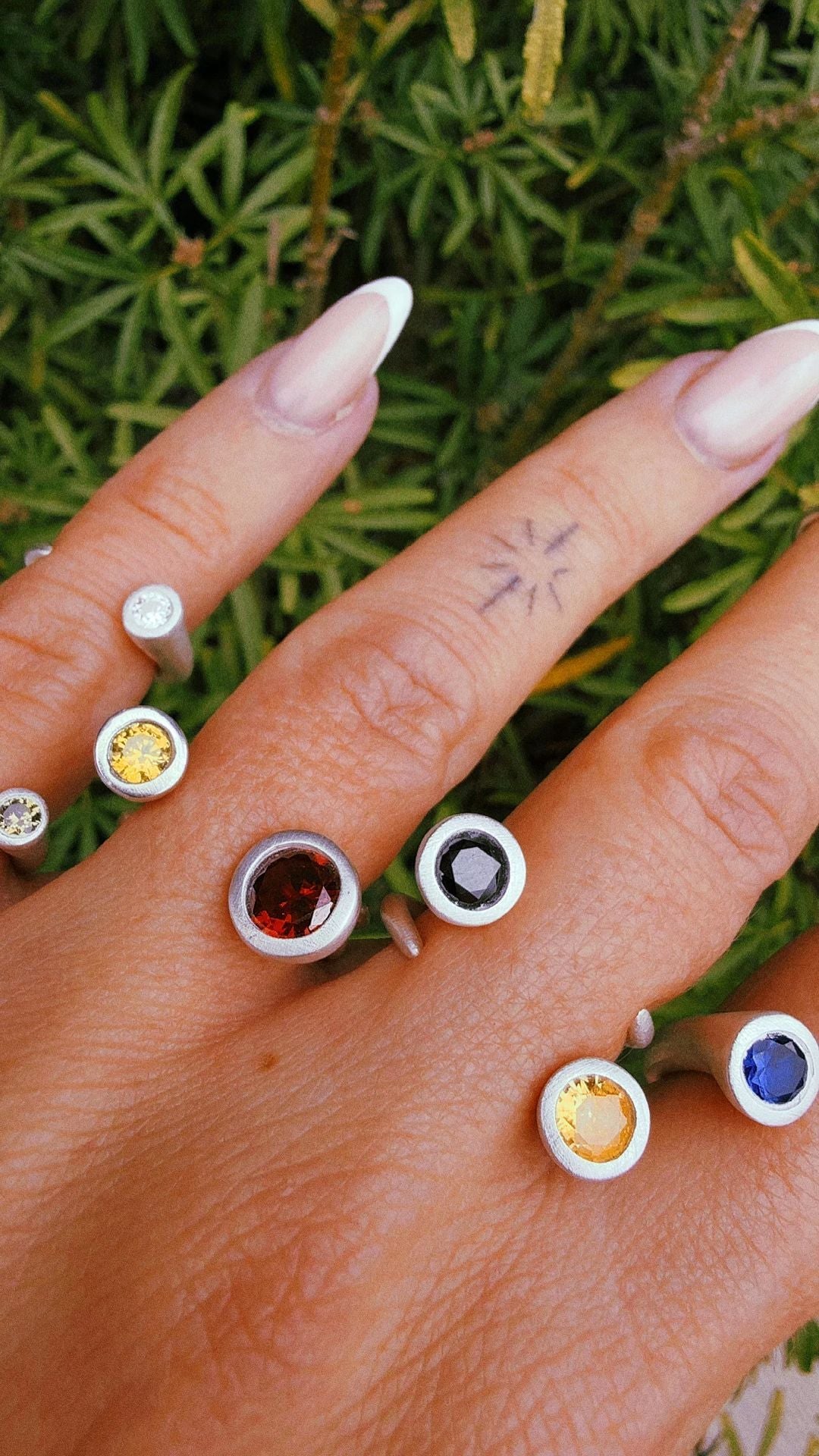
Matching jewellery for couples has an image problem. Say the phrase and most people picture two identical pendants bought in a hurry, worn twice, then quietly retired. It does not have to go that way. The pairs that get worn for years tend to follow one rule: each piece has to work on its own, and the match has to be something you notice rather than something that shouts. Here are the approaches that hold up, and how to make a pair yourselves.
Matching, not identical
Identical is the trap. Two people rarely have the same taste, the same job or the same tolerance for jewellery, so buying two of one thing usually means one of you is wearing something they did not choose. A better structure is to fix one element and let everything else differ. Fix the metal and finish, and vary the shape. Or fix the shape and vary the stone. Or make two entirely different pieces, a ring and a pendant, that share one pressed texture. The connection is still legible to anyone who knows to look, and both of you end up with something you actually like.
Ideas for matching jewellery for couples
- One texture, two forms. Press both pieces with the same fabric, bark or tool, then make one a band and the other a disc pendant. This is the most flexible option and the most forgiving of different tastes.
- Paired stones. The same setting in both pieces, with a different stone colour in each. Birth months are the obvious choice; the colours you each prefer work just as well.
- Interior engraving. A date, a place or a short word stamped on the inside of a band, invisible when worn. This suits people who would rather not advertise.
- Wide and narrow. Two bands of the same design in different widths. It looks deliberate rather than accidental, and it suits couples with very different hands.
- An everyday alternative. Some couples make a pair of plain bands themselves and keep those for daily wear, saving a bought ring for occasions.
Why fine silver suits a pair
If two pieces are going to be worn side by side, or compared in photographs, they need to age at the same rate. Plated jewellery rarely does, because wear depends on how each person uses their hands. Fine silver is 99.9% silver throughout, so a scratch reveals more of the same metal rather than a different one underneath, and both pieces stay recognisably a pair.
Making the pair together
Silver clay is what makes this a realistic weekend project rather than a workshop course. You shape it by hand, let it dry, then fire it with a torch, and it becomes 99.9% fine silver. There is no soldering and no kiln required. The main thing to plan for is shrinkage of roughly 8-10% as the binder burns away, which matters most for rings: build each band larger than the finished size you want.
Work from one batch of clay and one rolled sheet if you can, because that is what makes two pieces look related. For the process itself, how to use silver clay covers the basics and how to make a silver clay ring takes you through a band step by step. The silver clay starter kit includes the clay, a torch, the tools, a cubic zirconia and instructions, which is enough for two modest pieces, and silver clay on its own covers you if you want more material for wider bands. We ship worldwide and cover the duties.
A realistic expectation
The first pair will not be flawless, and that is worth saying plainly. Edges will be slightly uneven and one band will sit a little differently from the other. In practice this is the part people end up liking. Bought matching jewellery for couples is interchangeable by definition; a pair you made on a Sunday afternoon is not, and that difference is what keeps both pieces in use rather than in a box.