

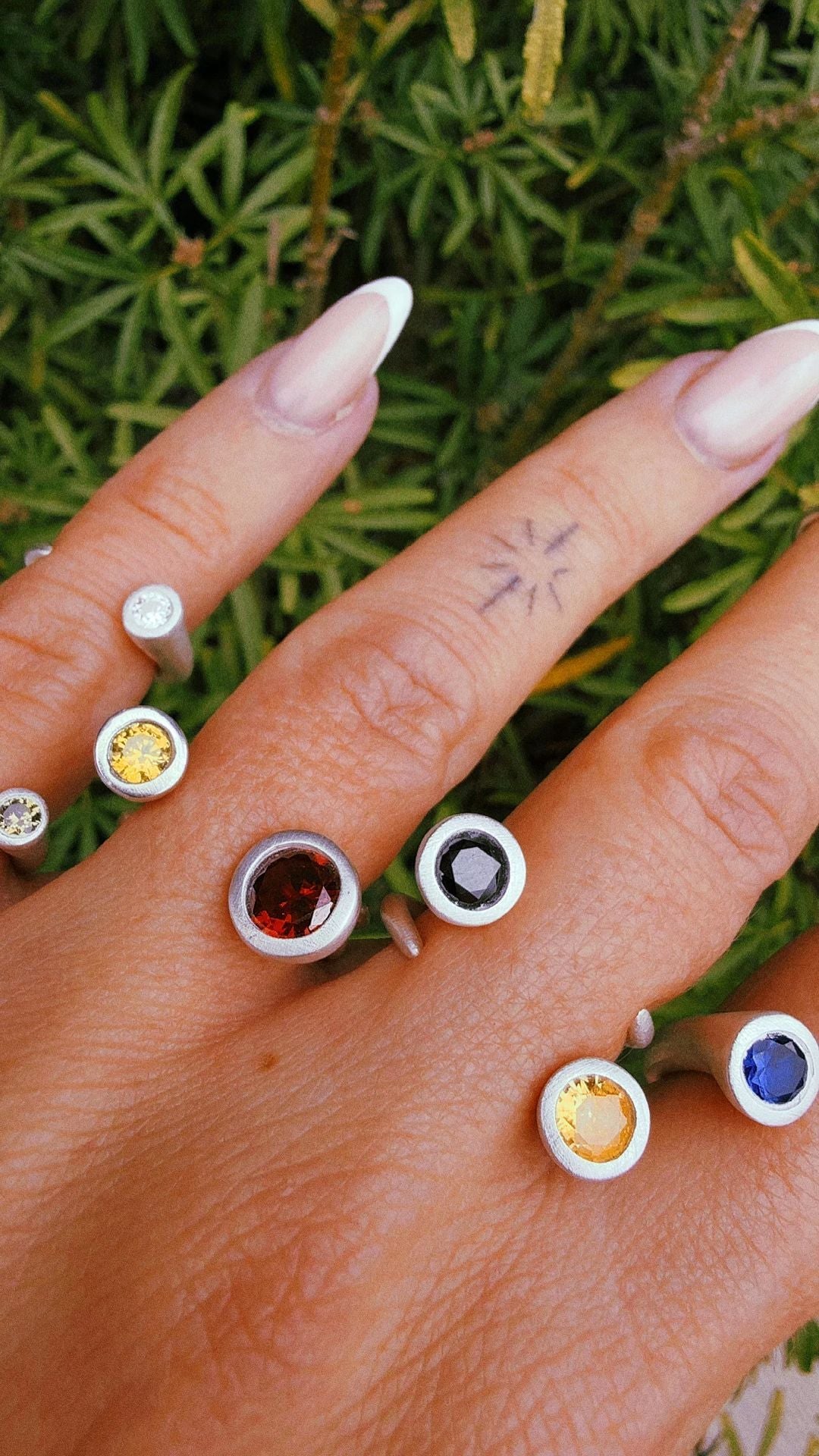
Mother and child birthstone jewelry is one of the few personalised pieces that ages well. A necklace or ring carrying the stones of her children says something specific, and it keeps saying it twenty years later. The catch is that most shop-bought versions look identical to each other, and the good ones cost more than people expect. Making it yourself solves both problems.
What mother and child birthstone jewelry usually looks like
Three shapes dominate. A pendant with one stone per child, often on a small bar or disc. A ring with two or three stones set across the band. And a set of stacking rings, one stone each, worn together. All three work because they scale: another child means another stone rather than a redesign.
The version people actually wear tends to be the understated one. Small stones, plenty of silver around them, nothing that needs explaining at a school gate. Keep that in mind before you plan something with six settings on it.
Why silver clay suits this particular project
Silver clay is fine silver powder held in a binder. It handles like modelling clay while damp, so you can press a stone straight into the surface before it dries. When you fire the piece the binder burns away and the silver contracts around the stone, holding it without any soldering or claw setting. What is left is 99.9% fine silver, with a shrinkage of roughly 8-10%.
That shrinkage is the mechanism, not a flaw. It is what grips the stone. It also means a ring should be made slightly larger than the finished size you want.
Choosing stones that survive the torch
This is the part that catches people out. Many natural gemstones crack, cloud or lose their colour when heated, so they cannot be fired in place. Cubic zirconia is the usual answer: it is lab-grown, it comes in a wide range of colours, and it takes the heat without changing. For a birthstone piece that matters, because it lets you match the colour to the month rather than the material.
If you would rather set a natural stone, set it after firing rather than before. That is a different technique and a slower one, but it keeps the option open.
Where to start
Make one plain piece first, without a stone, to get a feel for how the clay dries and how much sanding it wants. Then make the real thing. The silver clay starter kit includes the clay, a torch, the tools, a cubic zirconia and instructions, which is enough for a first piece and a practice run.
For the underlying method, from rolling to firing, our complete guide to silver clay covers each step in order. Read the section on drying properly; it is the one people skip and then wonder why a piece cracked.
A note on doing it at all
Bought birthstone jewellery is fine. But a mother wearing a piece her own hands made, holding stones for her children, is a different object entirely. It takes one evening and it does not need a workshop.