

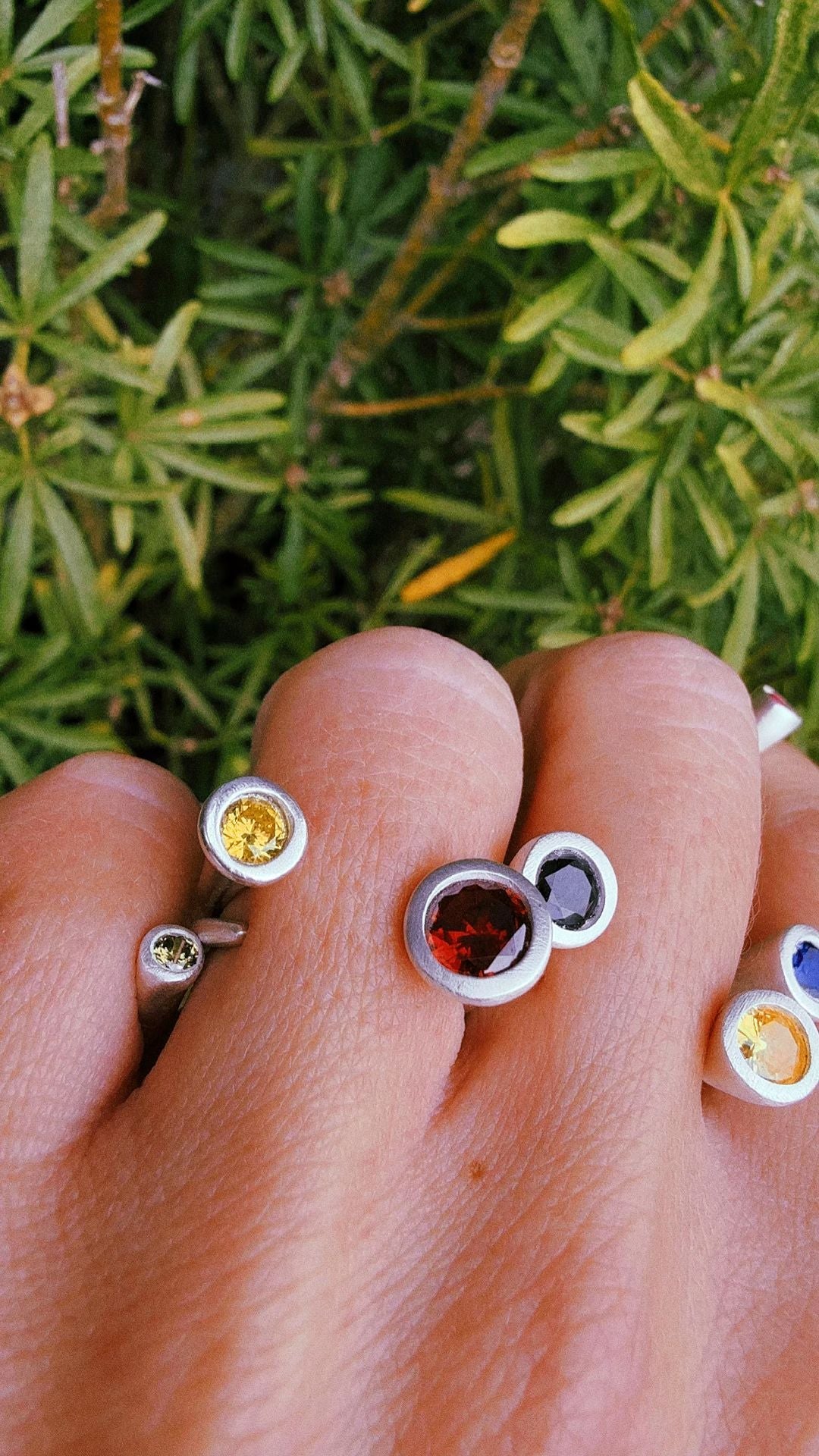
Wire wrapping is the technique of shaping metal wire around a stone or a bead, using loops, coils and bends instead of heat, to hold everything in place. It is one of the few ways to make jewellery with no flame and no chemicals, which is exactly why so many people start there.
It is also the technique people most often outgrow, usually for the same reason: there is a limit to what wire alone can express. This is a fair look at what wire wrapping does well and where silver clay is the better tool.
What wire wrapping actually involves
At its simplest you need wire, a pair of round-nose pliers, a pair of flat-nose pliers and side cutters. The wire is usually copper, brass or sterling silver, sold by gauge. Thicker wire holds structure; thinner wire does the binding and decorative coiling.
The core skills are a neat loop, a consistent coil, and a wrap that grips a stone without hiding it. None of them are difficult to understand. All of them take practice to do tidily, which is the honest bit most tutorials skip over.
What wire wrapping is genuinely good at
Setting stones you cannot drill or fire. A tumbled crystal, a beach pebble, a piece of sea glass. Wire holds them mechanically, without heat, so nothing has to survive a flame.
Reversibility. If you do not like it, you unwrap it. The stone is unharmed and the wire is mostly reusable.
A very low cost of entry. Copper wire and one pair of pliers will get you started for the price of a coffee.
Where wire wrapping runs out of road
Wire is a line. It can outline a shape, but it cannot become one. If you want a solid form with a texture, a fingerprint, a stamped word or a modelled surface, wire cannot give you that on its own.
There is a durability question too. A wrapped setting relies on tension. Wire work catches on clothing, loosens over years, and the ends can be sharp if they are not tucked well. Traditional jewellers solve this by soldering, which brings back the flame and the flux that wire wrapping was meant to avoid.
How silver clay compares
Silver clay approaches the problem from the other direction. It is fine silver powder held in a soft binder, so you model it like clay rather than bending it like wire. Once it is dry you fire it with a small handheld torch, the binder burns away, and what is left is 99.9% fine silver.
That means solid forms rather than outlines. Texture, lettering and fingerprints press straight into the surface and survive firing. It also means no soldering, which is the point worth dwelling on: the joints are made while the material is still soft, so there is no separate joining step at all. Our post on making a silver clay ring shows how that works on a real piece.
The trade-off is shrinkage. The piece contracts by roughly 8-10% in the flame. For a textured pendant this only sharpens the detail, but anything sized to fit has to be made slightly oversized to start with.
Which should you learn?
They are not really rivals. If you mostly want to set found stones and crystals without heat, wire wrapping is the right skill and there is no reason to complicate it. If you want to make the metal part itself, a pendant with a texture, a ring with a stamped date, a charm shaped by hand, then wire is the wrong tool and silver clay is the direct answer.
A good many people end up doing both: a silver clay piece as the focal element, with wire work for the fittings around it.
Trying silver clay
The silver clay starter kit contains the clay, a torch, the tools, a cubic zirconia and the instructions, so there is nothing else to source before a first project. We ship worldwide and cover duties, so the price you see is the price you pay.
Before ordering, the complete guide to silver clay covers what the material can and cannot do in more detail.