

Kids jewelry making has a reputation for plastic beads on elastic cord that snaps within a week. It does not have to be that. Children are often better at the fiddly, patient parts of jewellery than adults expect, and the results can be pieces they actually keep. The trick is matching the technique to the age, and being honest about which steps belong to a grown-up.
What kids jewelry making looks like at each age
Around four to six, the useful skill is threading. Large wooden or ceramic beads, a thick cord and a blunt needle are enough. Nobody needs a kit for this, and attention spans are short, so keep projects to one sitting.
Six to nine is where fine motor control arrives. Smaller beads, simple knotting and basic wirework with pre-cut lengths all become possible. This is also the age where children start caring whether the finished thing looks good, which is worth encouraging rather than rushing past.
Nine to twelve is the sweet spot for shaping. Modelling, stamping, pressing textures and using moulds all suit this age, and the work starts to look genuinely handmade rather than assembled. From twelve upwards, most children can handle real materials and real tools with supervision, and that is usually when a hobby either sticks or fades.
Where silver clay fits in
Silver clay is worth knowing about here because it splits neatly into a child's job and an adult's job. It is a soft, pliable material shaped much like modelling clay, then fired. After firing it is 99.9% fine silver, and the piece shrinks by roughly 8-10% as the binder burns away.
Everything before the firing is safe, quiet, unhurried work: rolling, stamping, cutting shapes, pressing in a texture. That is the part children are good at, and it is the part that decides how the finished piece looks.
The steps an adult should keep
Firing is the line. Our clay is torch-firable, and a torch is not a child's tool. The adult does that step, every time, with the child watching from a sensible distance. Finishing with files and brushes is fine for older children under supervision.
If you want the full sequence before you decide, the complete guide to silver clay walks through it, and how to use silver clay covers the practical handling.
Making pieces they will actually keep
Two things decide whether a piece survives past the first month: material and meaning. Plastic and elastic fail quickly, and children know it. Something in solid silver, with their own fingerprint or initial pressed into it, tends to end up worn rather than lost in a drawer.
Keep the first project small: a charm, a simple pendant, a textured disc. Small pieces dry faster, fire faster and forgive more. Ambition can wait for the second attempt.
What you need to start
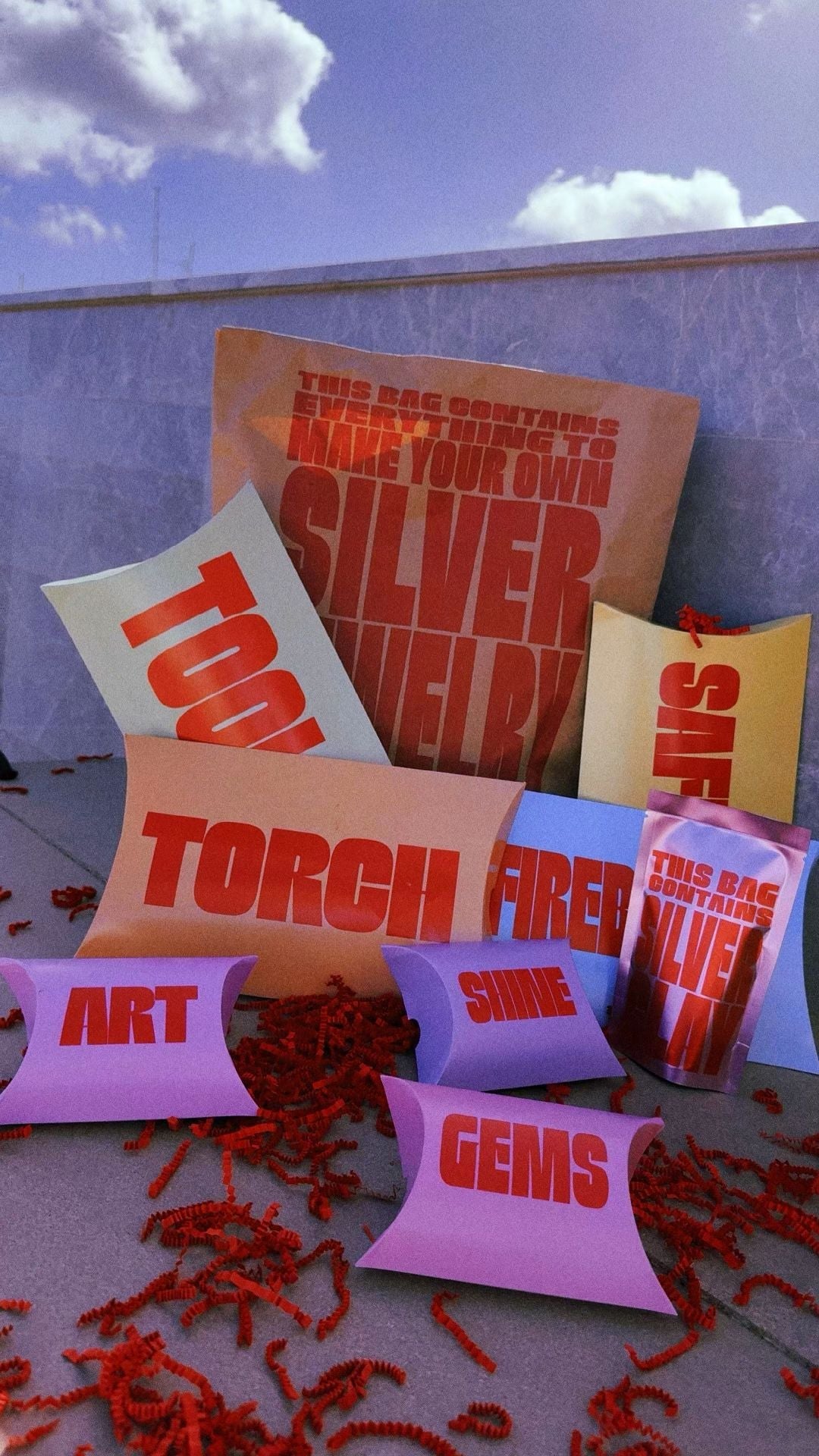
You do not need a workshop. The silver clay starter kit contains the clay, a torch, the tools, a cubic zirconia and printed instructions, which covers a first project without hunting for extras. We ship worldwide and cover any duties.
Start with one afternoon, one small piece and low expectations. If it works, the second piece is always better than the first.