

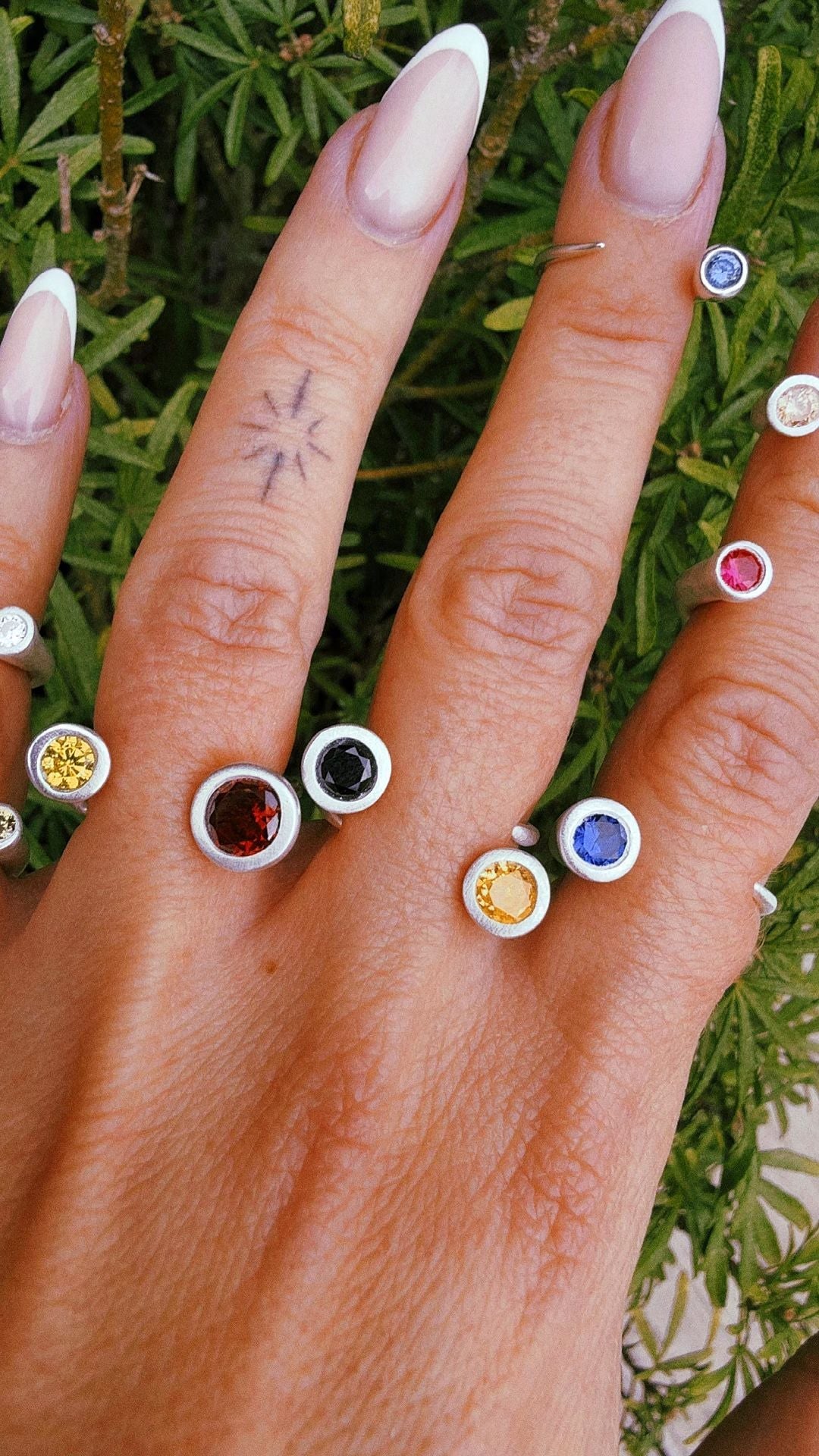
Cubic zirconia turns up in almost every jewellery shop and in most beginner stone-setting kits, usually with very little explanation attached. It is worth understanding what the material actually is, because it behaves differently from both diamond and natural coloured stones, and that difference matters a great deal if you are setting one yourself.
What is cubic zirconia?
Cubic zirconia is a lab-grown crystal made from zirconium dioxide. It is not a natural gemstone dug out of the ground, and it is not a treated or lower grade of diamond. It is its own material, produced deliberately in a furnace, and it has been made commercially since the 1970s.
Because it is grown rather than mined, it comes out clean, consistent and cheap. A jeweller can order a hundred stones in exactly the same size and colour, which is almost impossible with natural gems at any sensible price.
Cubic zirconia and diamond are not the same thing
The two look similar to the naked eye, and that is the whole reason cubic zirconia became popular. They are not the same material, though, and a few differences show up quickly in use.
Cubic zirconia sits around 8 to 8.5 on the Mohs hardness scale. That is hard enough to resist most everyday knocks, but softer than diamond at 10, so a stone worn daily in a ring will pick up fine surface scratches over years in a way a diamond will not.
It is also noticeably denser, so a cubic zirconia feels heavier than a diamond of the same size, and it throws more coloured flashes of light.
None of that makes it a lesser stone. It makes it a different one, best described honestly for what it is rather than sold as something else.
Colours and sizes
Clear is the most common, but cubic zirconia is made in a wide range of colours, which is where it becomes genuinely useful for handmade work. You can pick a deep red, a blue or a warm yellow without paying natural-gemstone prices, and try several before committing.
Sizes are quoted in millimetres across the widest point. For a first piece, something between 3 and 5 mm is easy to handle and easy to set neatly. Anything much smaller becomes fiddly, and anything much larger needs a well-made setting to hold it securely.
Using cubic zirconia in silver clay
This is where cubic zirconia earns its place on a jeweller's bench. A stone can be pressed into the soft clay and held in position while the piece is shaped, so the setting forms around it rather than being built separately afterwards.
The clay is then dried and torch-fired, coming out as 99.9% fine silver and shrinking by roughly 8 to 10% in the process. That shrinkage works in your favour here, because the metal closes in around the stone as it fires. Our guide to setting gemstones in silver clay covers the practical side in more detail.
The silver clay starter kit includes cubic zirconia alongside the clay, torch, tools and instructions, so a stone-set piece is possible from the first attempt rather than something to work up to. If you would rather start with a plain band and add a stone later, how to make a silver clay ring is the place to begin.
Looking after cubic zirconia
Warm water, a drop of washing-up liquid and a soft brush will lift most of what dulls a stone, which is usually skin oil and soap film rather than damage. Dry it properly afterwards so nothing collects underneath the setting.
Take rings off before anything abrasive, and store pieces so stones are not rubbing against each other. Cubic zirconia clouds over time mainly through surface scratching, and most of that happens in a jewellery box rather than on the hand.
Is it worth using?
For handmade jewellery, yes. It gives you a bright, hard, consistent stone in any colour you like at a price that lets you experiment, which is exactly what you want while you are still learning to set. Describe it accurately when you sell or give the piece away, and cubic zirconia does its job perfectly well.