

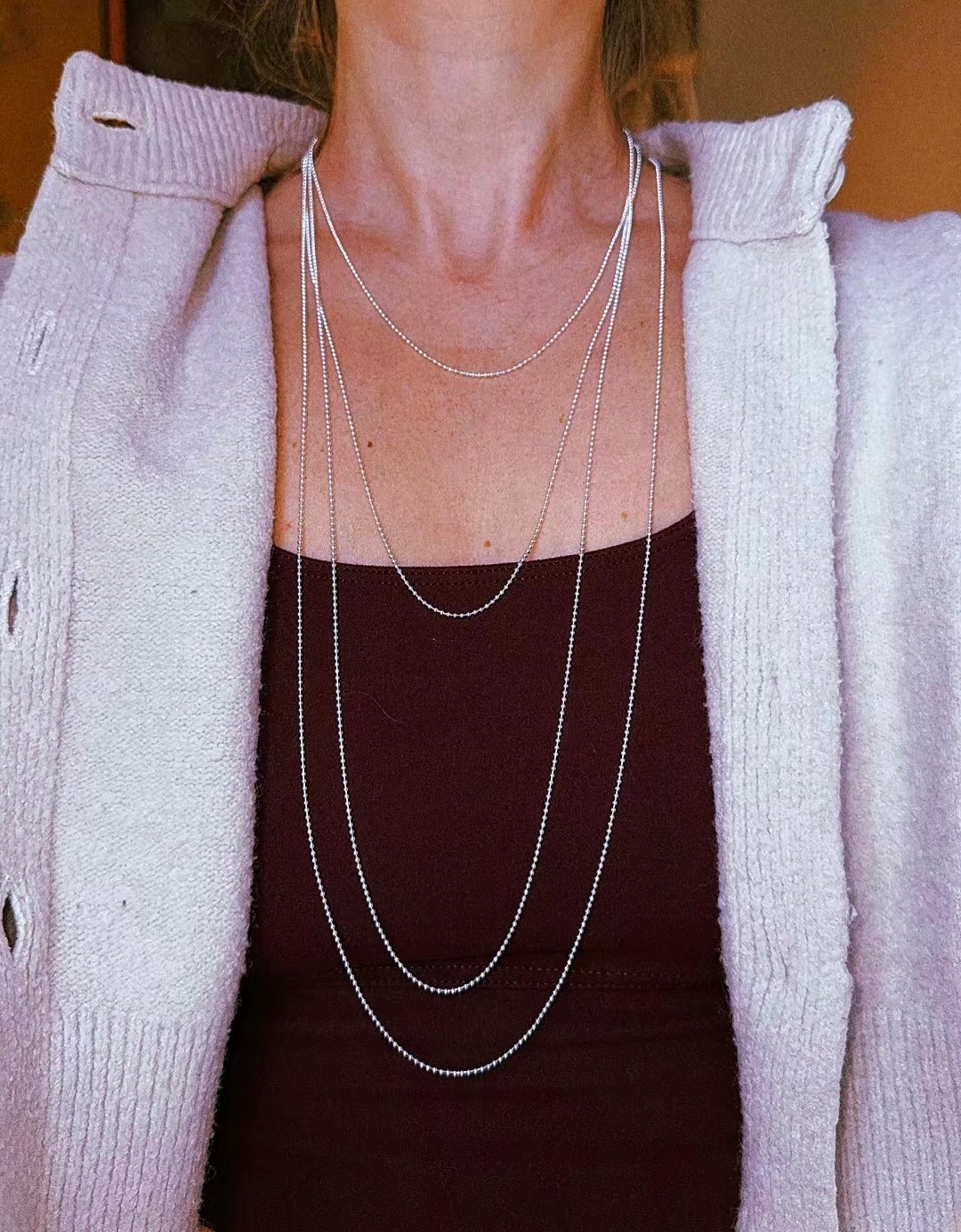
Buying a chain online is mostly guesswork unless you know where each length actually sits. This necklace length chart sets out the standard sizes, what they are called, and where they fall on the body, so you can pick a chain for a pendant without measuring twice.
How necklace lengths are measured
Length is measured end to end with the clasp closed. It includes the clasp but not the pendant. So a 45 cm (18 inch) chain forms a loop 45 cm around, not a strand hanging 45 cm down.
Roughly half of that number is how far the chain drops from the back of your neck, which is why a pendant on an 18 inch chain sits near the collarbone rather than at the waist.
Necklace length chart
- 35 to 37 cm (14 inch), collar: sits tight around the base of the neck.
- 40 cm (16 inch), choker: rests in the hollow of the throat.
- 45 cm (18 inch), princess: falls just below the collarbone. This is the most commonly sold length and the safest choice for a gift.
- 50 to 55 cm (20 to 22 inch), matinee: lands between the collarbone and the top of the bust.
- 60 cm (24 inch): sits at or just below the bust and clears most necklines.
- 75 to 90 cm (30 to 36 inch), opera: reaches the breastbone or lower and can be doubled.
- 90 cm and over, rope: long enough to wrap twice or knot.
Why the same length looks different on different people
A chart is a starting point, not a rule. Neck circumference, height and shoulder width all shift where a chain lands, and the same 18 inch necklace can sit above the collarbone on one person and below it on another.
If you are buying for someone else, err on the longer side. A chain that hangs slightly low still reads as intentional, while one that is too tight does not.
Matching the chain to the pendant
A heavy pendant needs a chain with enough body to carry it without kinking, and a delicate one gets lost on a thick chain. Length matters here too: the longer the chain, the more room a large pendant has to sit without crowding the neckline.
For a piece you have made yourself, hang it on a chain before you decide the bail is finished. The angle it hangs at changes how the front face reads, and that is difficult to judge while the pendant is lying flat on the bench.
Layering several lengths
Layering works when there is a clear gap between each chain, usually 5 cm or more. A common set is 40, 45 and 55 cm, which gives three distinct lines rather than three chains competing for the same space.
Mixing widths helps as well: one fine chain, one heavier, and one carrying the pendant.
Measuring at home
Take a piece of string, hang it around your neck at the height you want the pendant to sit, mark where the ends meet at the back, then lay the string flat against a ruler. That measurement is your chain length.
Making the pendant yourself
If you would rather the pendant matched the chain than the other way round, silver clay lets you shape one by hand. It is fired with a torch and comes out as 99.9% fine silver, shrinking by roughly 8 to 10% along the way, so allow for that when you size the bail. Our complete guide to silver clay walks through the whole process, and the silver clay is sold on its own if you already have the tools.