

There are more types of earrings than most people realise, and the names get used loosely. A huggie is a hoop, a threader is a kind of drop, and an ear cuff is barely an earring at all in the usual sense. This guide sets out the main styles and what actually separates one from another, then covers the fittings behind them, which types are realistic to make yourself at home, and the rest of the jewellery vocabulary you will meet along the way. If you want the same treatment for the other two big categories, there are companion guides to types of bracelets and necklace chain types.
The main types of earrings
Studs
The simplest of all earring types. A stud sits flat against the earlobe on a short post, held in place with a butterfly or a screw back. Because there is no movement and no dangling weight, studs are comfortable enough to sleep in, and they are usually the first earring someone owns after a piercing.
Studs are also the easiest style to make. A small flat shape, a post added at the back, and you have a finished pair — which is why silver clay earrings so often start here.
Hoops
A hoop is a continuous ring that passes through the ear. Sizes run from tiny sleepers to large statement hoops, and the wire can be round, square or twisted. Larger hoops swing and catch the light, which is why they read as bolder than a stud made from the same metal. Weight is the thing to watch: a wide hoop in solid silver is heavier than it looks on the page.
Huggies
Huggies are very small hoops that sit against the lobe rather than hanging from it, usually between 8 mm and 14 mm across and closing with a hinged snap. They have become one of the most worn styles because they stack well along a second or third piercing. There is more detail in our guide to huggie earrings, including why the hinge is the one part most home makers buy rather than build.
Drops, dangles and chandeliers
A drop hangs below the earlobe from a fixed fitting. A dangle moves freely; a chandelier is a drop with several tiers. All of them put weight below the ear, so keep the metal light if you are making them yourself and pierce the hanging hole before the piece is fired rather than after.
Threaders
A threader is a fine chain that slips straight through the piercing and hangs on both sides, with no clasp at all. It is the lightest way to get real length, and the one style where the chain itself is the whole design.
Ear cuffs and climbers
Not every earring needs a piercing. An ear cuff grips the cartilage along the outer edge of the ear and stays put by gentle pressure alone, and a climber runs up the lobe rather than hanging down from it. Both give the impression of several piercings without any. Cuffs come as plain bands, wraps that curl round more than once, chained versions linked to a stud below, and wider statement pieces.
Clip-ons and screw backs
Clip-ons hold the lobe between two pieces of metal, and screw backs tighten with a small threaded post. Both exist for unpierced ears, and both have a reputation for pinching, which is mostly down to how much pressure the fitting applies rather than the design itself.
Earring fittings, and the gauge number nobody explains
Gauge measures the thickness of the post or wire, and it runs backwards: the higher the number, the thinner the metal. Twenty gauge, about 0.8 mm, is the usual thickness for a standard lobe piercing and for most commercially made studs. Eighteen gauge, about 1.0 mm, is the other common standard and slightly sturdier. Twenty-two gauge, about 0.6 mm, will pass through anything but can feel flimsy, and sixteen gauge, about 1.2 mm, belongs to cartilage rather than lobes. Post length matters too — most studs use 9 to 11 mm.
The practical rule is that a thinner post fits a piercing made for a thicker one, but not the other way round. Our guide to earring gauge size goes through the measurements properly. The fittings themselves — posts, hooks, hinges, jump rings — are covered in the post on jewellery findings, and if you would rather make your own hooks, sterling silver wire is the material for it. If a pair has ever irritated your ears, that is usually the fitting rather than the earring: see nickel-free jewellery and why silver sometimes marks the skin.
Which types of earrings can you make at home?
Studs, small hoops, drops and charms are all within reach with silver clay, which behaves like modelling clay while you work and is real silver once fired. You shape it by hand, let it dry, then fire it with a torch; what comes out is 99.9% fine silver. It shrinks by roughly 8 to 10% along the way, which matters far more for rings than for earrings — one of the reasons earrings make a sensible first project. How to use silver clay covers the whole sequence, torch firing has a guide of its own, and if you are new to making altogether, start with jewellery making for beginners and the tools worth owning first.
Four designs that tend to work first time
Textured discs, where a texture sheet, a leaf or a piece of lace does all the work. Organic shapes, where slight irregularity reads as intentional. Stone-set studs, pressing a cubic zirconia into each shape before drying — fire only cubic zirconia and lab-created corundum or spinel, and set anything else after firing. And small drops, with a hole made while the clay is leather-hard. Work on both earrings at every stage rather than finishing one and starting the other; hands drift over an hour.
Findings come after firing, but holes come before
The decorative part is what you make; the finding is added afterwards. Posts are glued to a sanded flat back with a jeweller's epoxy, hooks hang from a hole, and a hole pierced in damp clay takes two seconds where the same hole in fired silver takes a drill. Remember the hole shrinks with everything else, so make it a size larger than you think you need. The same logic applies to a pendant bail: build it in while the clay is soft.
What to make once a pair has worked
A pendant is the natural next step, then a ring, charms or a bracelet. There are more starting points in silver clay ideas, and what is metal clay explains where silver sits among the other clays.
The rest of the jewellery vocabulary
Earring names are only one corner of it. These are the terms that come up most often, each with a guide behind it.
Necklaces and chains
Chain types decide how a pendant hangs, the length chart decides where it sits, and the bail is the small loop joining the two. Then there are named styles: a locket, a lariat, a friendship necklace.
Bracelets and anklets
Types of bracelets is the overview; beyond it sit the cuff, the tennis bracelet, the permanent bracelet and the silver anklet.
Rings, and what they are said to mean
Which finger a ring goes on carries more meaning than most people expect: see ring finger meaning and thumb rings, plus the promise ring and the claddagh. By style there is the signet ring, stacking rings, fine silver rings, the engraved ring and the birthstone ring. Sizing has two guides of its own — measuring with string and resizing.
Pieces that are neither earrings, necklaces nor rings
A brooch pins rather than hangs, cufflinks fasten rather than decorate, and beads are the component that turns up in all of them.
Stones, settings and surface work
A cabochon is a stone polished to a dome rather than faceted, and a bezel is the rim of metal that holds one. For surfaces: filigree, keum-boo, enamel, oxidised silver and hand stamping all do different things to the same piece of metal.
Silver marks and the metals behind them
925 means sterling and 999 means fine silver, which is what silver clay fires to — the difference is set out in sterling versus fine silver. Vermeil, silver plate and rhodium plating are coatings rather than solid metal, and how to tell if silver is real is the test for everything else. For comparisons: sterling against white gold, against stainless steel, and whether sterling counts as fine jewellery.
Looking after silver earrings
Fine silver tarnishes more slowly than sterling because it contains no copper, but it will still dull in humid air. A polishing cloth handles most of it in a minute; cleaning silver at home covers the rest. Take earrings out before swimming — can sterling silver get wet explains why — and store them dry rather than loose in a bag. Pairs you have stopped wearing are worth keeping: see what to do with old jewellery and heirloom jewellery.
Frequently asked questions
Which type of earring is most comfortable to wear every day?
Studs and huggies, because neither hangs or swings. Both sit close to the lobe, stay clear of hair and clothing, and are light enough to forget about.
Can you wear earrings without a piercing?
Yes. Ear cuffs grip the cartilage by tension, and clip-ons and screw backs hold the lobe between two pieces of metal. A cuff is usually the more comfortable of the two.
What gauge are most earrings?
Twenty gauge, about 0.8 mm. If a listing does not say, that is the safe assumption, and it will fit piercings made at either 20 or 18 gauge.
Can you make earrings at home without a kiln?
Yes — silver clay is torch-firable, so a small pair can be fired on a firing brick with a handheld torch. The starter kit guide sets out what that takes.
Which earrings are best for a first attempt?
A pair of textured studs. No sizing, no clasp, very little clay, and the texture does most of the design work for you.
Do handmade silver earrings make good gifts?
They tend to, because a pair costs little in material and reads as personal — see handmade silver jewellery, matching jewellery for couples and keepsake jewellery for what people actually make.
Where to start
Pick by how the earring will be worn rather than by how it looks flat on a table. Studs and huggies for every day and for stacking, hoops for something visible without much weight, drops for occasions, cuffs where there is no piercing to work with. Most people end up with a small set covering two or three of these rather than one pair meant to do everything.
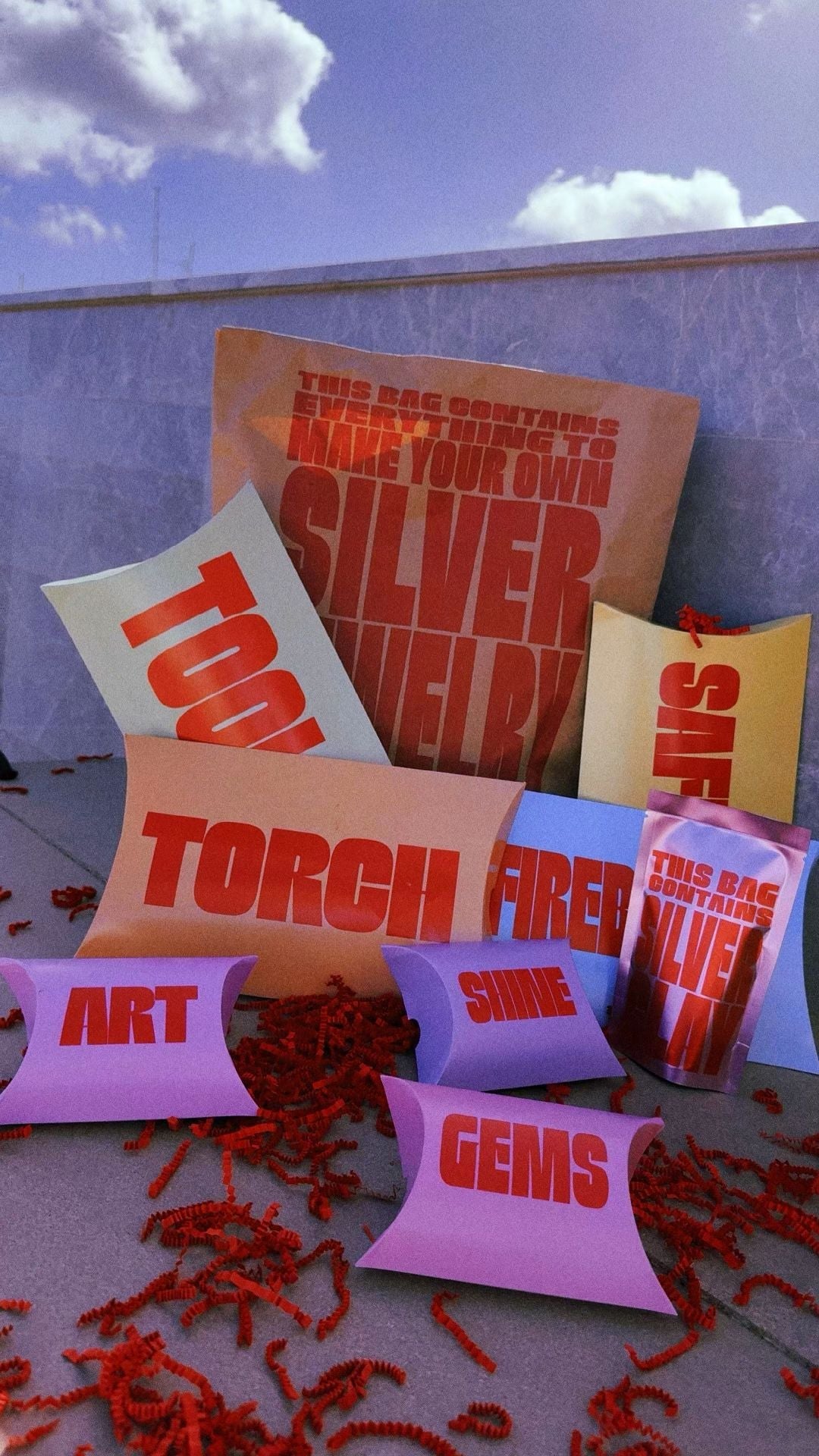
If you want to make them, the silver clay starter kit includes the clay, a torch, the tools, cubic zirconia and instructions — everything a first pair needs, with no kiln. Silver clay on its own is the refill once you have the kit, and the rest sits in the silver clay collection and supplies. If you are buying for someone else, the jewellery making kit guide is the one to read. We ship worldwide and cover import duties, so the price you see is the price you pay.