

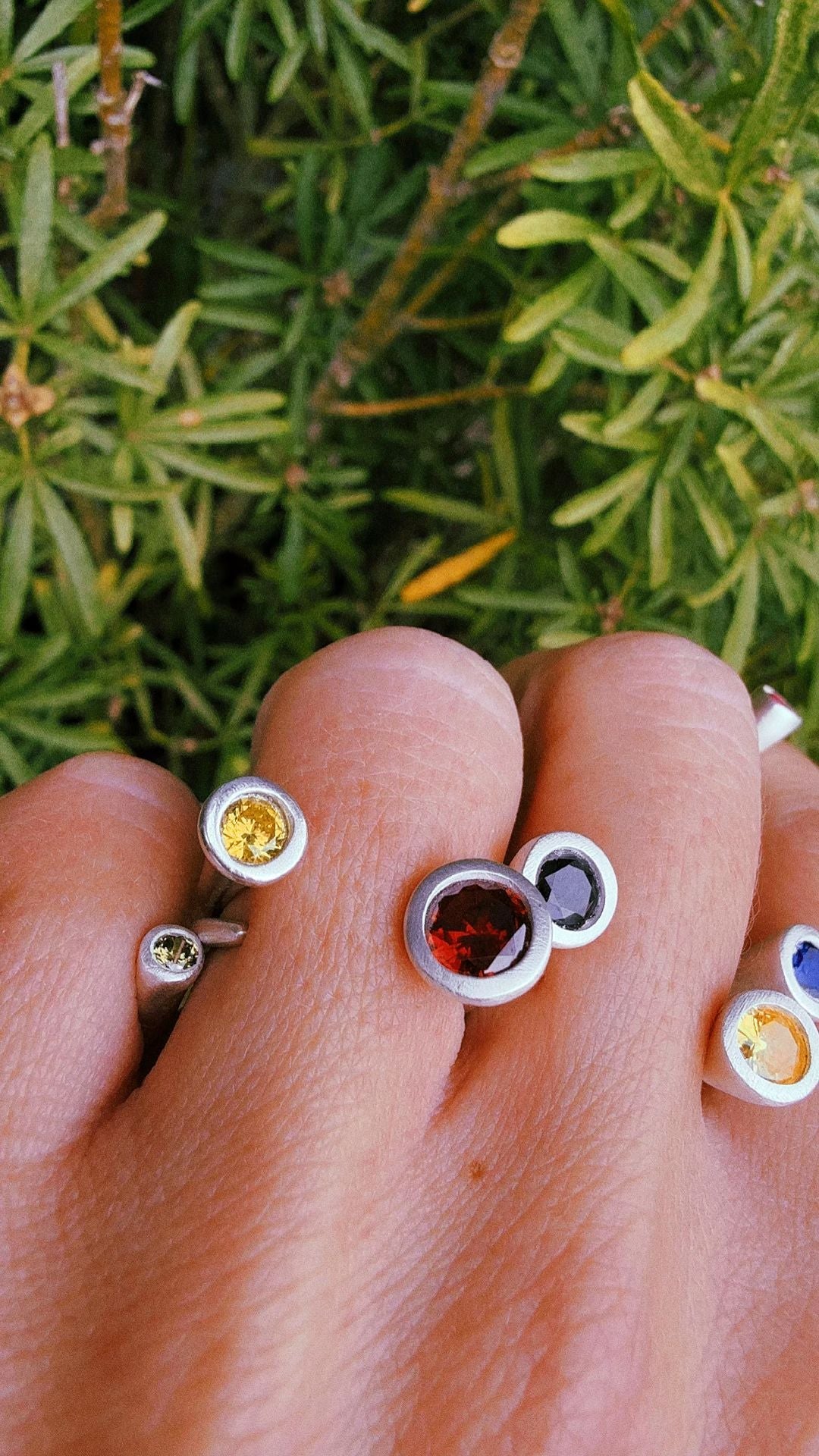
Ask ten people about thumb ring meaning and you will get ten answers, which is much of the appeal. A ring on the thumb sits outside the usual code. It is not an engagement ring, not a wedding band, not a signet with a family crest behind it. The thumb is the one finger where the wearer largely decides what the ring says. Here is where the tradition comes from, what a thumb ring tends to signal now, and how to make one that actually fits.
Where thumb rings come from
Thumb rings are old, and their earliest uses were practical rather than symbolic. Archers across Asia and the Middle East wore broad rings of horn, stone or metal to protect the thumb when drawing a bowstring, and the archer's ring is still made today for traditional shooting. Elsewhere, the thumb was simply the most visible place to put a large or valuable stone, which is why thumb rings turn up in portraits of wealthy sitters from the sixteenth and seventeenth centuries. Neither tradition attached romance to the finger, and that absence is exactly why the thumb stayed free for other meanings.
What thumb ring meaning tends to be today
Readings vary by person and by place, but a few come up again and again:
- Independence. The most common association by far. Because the thumb carries no relationship convention, a ring there often reads as standing on your own terms.
- Confidence. Thumb rings are usually wider and more visible than rings on other fingers, so they tend to be worn by people who are happy to be noticed.
- Family or friendship. Plenty of people move an inherited ring to the thumb for the plain reason that it is the finger it fits.
- Identity. In some circles a thumb ring has been used as a quiet signal of queer identity. This is far from universal and is not something to assume about a stranger.
- Nothing in particular. Some wearers just like how it looks, and that is a complete answer.
Left hand or right makes little consistent difference. If you want a practical rule, the dominant hand knocks a ring about more, so a sturdier design lasts better there.
What makes a good thumb ring
The thumb is broader and flatter than the other fingers, and it changes shape considerably as you move it. Two things follow. First, measure late in the day, and measure the knuckle as well as the base, because the ring has to pass the joint and then not spin once it is on. Second, favour a wider band. A very thin band looks lost on a thumb and tends to twist; something in the region of four to eight millimetres sits far better. Rounded inner edges make a wide band comfortable rather than restrictive.
Making a thumb ring yourself
A thumb ring is a good first project precisely because it is chunky. Small irregularities that would show on a delicate band read as texture on a wide one. Silver clay suits it well: you shape it much like modelling clay, let it dry, then fire it with a torch, and what remains is 99.9% fine silver. The clay shrinks by roughly 8-10% as the binder burns away, so build the band slightly larger than your finished size and allow for that before you cut it.
If you have not worked with the material before, start with the complete guide to silver clay, then follow the step-by-step in how to make a silver clay ring. The silver clay starter kit includes the clay, a torch, the tools, a cubic zirconia and instructions, which covers everything a first ring needs. If you already have the kit and simply want more material, silver clay is available on its own. We ship worldwide and cover the duties.
Living with it
Give a new thumb ring a week before you judge it. Most people find the first few days odd, because the thumb is in constant use and you notice the ring far more than you would elsewhere on the hand. After that it stops announcing itself, and what is left is the version of thumb ring meaning you chose for yourself.