

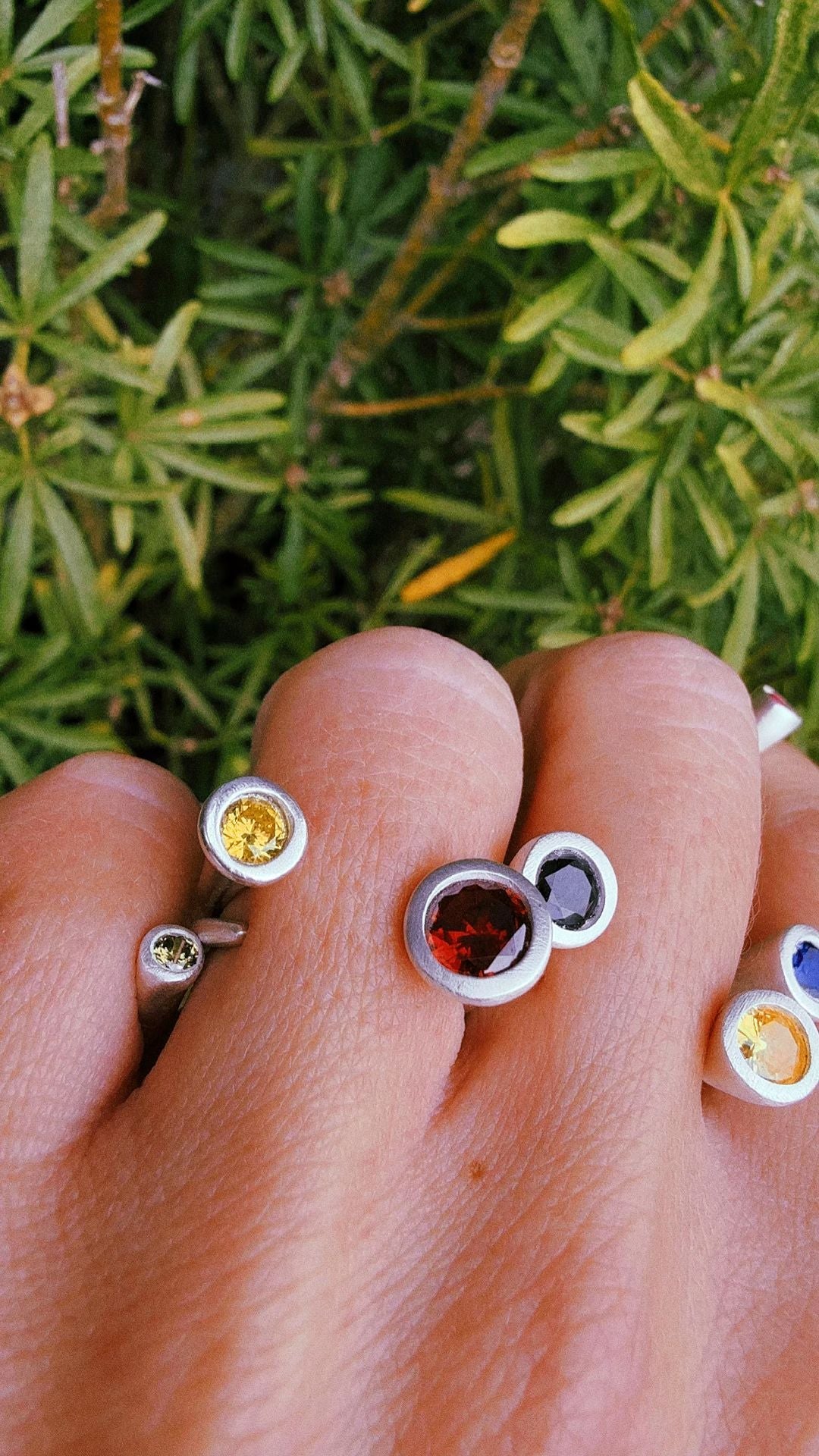
A birthstone ring is one of the few pieces of jewellery that explains itself. It is personal without being sentimental, it works as a gift for almost any occasion, and — if you make it yourself — it is a genuinely manageable project. Here is the month-by-month list, and how to build one in fine silver at home.
The birthstones month by month
The modern list used across most of the English-speaking world runs like this:
- January — garnet, deep red
- February — amethyst, purple
- March — aquamarine, pale blue-green
- April — diamond, clear
- May — emerald, green
- June — pearl, moonstone or alexandrite
- July — ruby, red
- August — peridot, yellow-green
- September — sapphire, blue
- October — opal or tourmaline
- November — topaz or citrine, golden
- December — turquoise, zircon or tanzanite, blue
Older and regional lists differ, and several months have more than one accepted stone, so there is room to pick whichever colour the wearer actually likes. Nobody is checking.
Choosing a stone that can take the heat
This is the detail that catches people out. If you are setting a stone into silver clay and firing it in place, the stone has to survive the firing. Lab-created stones such as cubic zirconia handle it well and come in colours that stand in convincingly for most birthstones — red, purple, blue, green, golden and clear are all readily available.
Many natural stones do not survive. Pearl, opal, turquoise and emerald in particular are heat-sensitive or contain water, and firing them will damage or destroy them. For those months, the answer is to fire the silver first and set the stone afterwards in a bezel or a prong setting, rather than firing it in place.
If in doubt, fire a test piece with a spare stone before committing to the real one.
The dependable list is short — cubic zirconia and lab-created corundum or spinel — and cubic zirconia comes in enough colours to stand in for most months. Everything else is set cold after firing, which the guide to setting gemstones in silver clay covers step by step.
How to make a birthstone ring
Silver clay is what makes this practical without a workshop. It is fine silver particles held in an organic binder, so you can roll and shape it like modelling clay. During firing the binder burns away and the piece becomes 99.9% fine silver. A small handheld torch is enough — no kiln is required — which is why this fits in an afternoon at a kitchen table. Our complete guide to silver clay covers the material in full.
The build itself is straightforward: roll a band to length, wrap it around a mandrel, add a small setting for the stone, press a fireable stone into place, let the piece dry completely, then fire, quench and polish. Our step-by-step ring tutorial takes each stage in order.
Sizing, and the shrinkage question
Silver clay shrinks by roughly 8-10% as it fires, and this trips up nearly everyone on a first ring. You cannot build to the finished size — you build oversized on the mandrel and let the firing bring it down. Measure the wearer's finger first, add the allowance, and mark the mandrel before you start rather than judging by eye.
Shrinkage is also why a spare band is worth making. If the first comes out a size too small, you will want the second attempt ready rather than starting from nothing.
Measure before you roll anything: sizing a finger with string or paper takes a minute and removes most of the guesswork, and knowing the target size is what lets you build in the shrinkage rather than hope for it.
Who a birthstone ring suits
Birthdays are the obvious occasion, but they are not the only one. A stone for each child works as a stacking set for a parent. A pair of matching bands with two different stones works for a couple or two sisters. And a single stone in a plain band is quiet enough to be worn daily, which is more than can be said for most sentimental jewellery.
A ring is not the only setting for a birthstone, either. Our guide to the types of earrings works as a glossary of the other styles and their fittings, and a small stone often shows better in a pair of studs than in a band that catches on everything.
If you want everything in one box, our silver clay starter kit includes the clay, a torch, the tools, a cubic zirconia and printed instructions. We ship worldwide and cover import duties, so there is nothing to pay on arrival.