

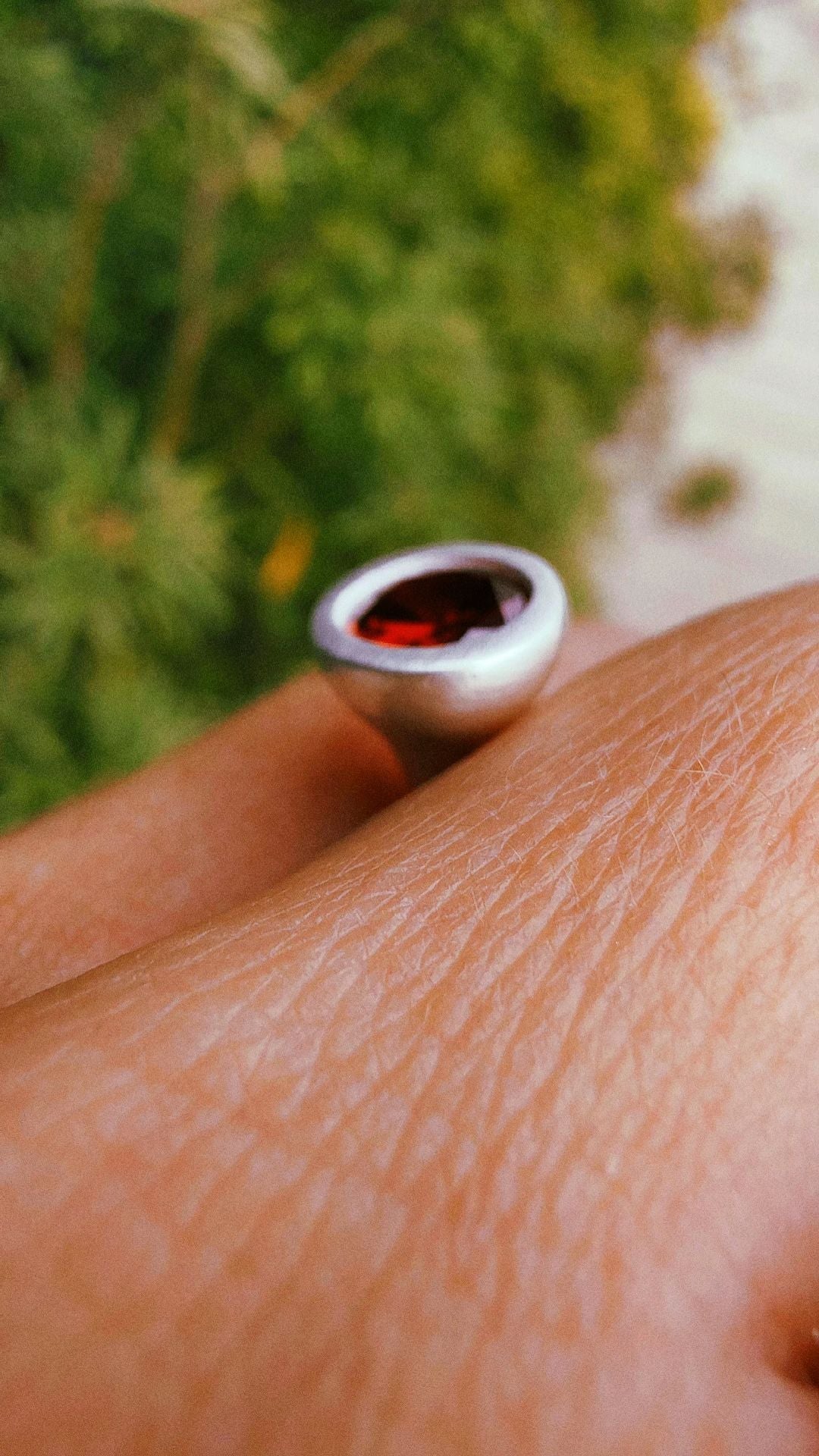
If you have ever taken an earring out after half a day because your earlobe was hot and itching, nickel free jewelry is not a marketing phrase to you. It is a practical requirement. Nickel is one of the most common contact allergens, and it turns up in a great many affordable pieces, usually in the alloy or the plating rather than anywhere on the label.
The reassuring part is that the metal is the one variable you can actually control. Once you know what a piece is genuinely made of, most of the guesswork disappears.
Where nickel usually hides
Nickel is cheap, hard and takes a bright polish, which is exactly why it ends up in costume jewellery. It is commonly used as a base metal underneath gold or silver plating, as an alloying metal in white gold, and in the springs, posts and clasps that nobody thinks about at the point of buying. A piece sold as "silver tone" may contain no silver at all.
Plating also wears. A pair of earrings that felt perfectly fine for a year can start causing trouble once the surface layer thins and the base metal underneath reaches skin.
Why fine silver counts as nickel free jewelry
Fine silver is 99.9% pure silver. There is no nickel in it by design, and very little of anything else. For anyone with sensitive skin that is the whole appeal: there is almost nothing in the metal to react to.
This is also exactly what silver clay becomes. The clay is fine silver powder held in an organic binder. When you fire it, the binder burns away and the silver particles sinter together, leaving a piece that is 99.9% fine silver. It is the same material as a sheet of fine silver, arrived at by a different route. The complete silver clay guide explains what happens at each stage.
Sterling silver is a separate question
Sterling silver is 92.5% silver and 7.5% other metals. Most often that balance is copper, which the great majority of people wear without any difficulty at all. But "7.5% other metals" is a description rather than a guarantee, and alloys vary between manufacturers.
Fine silver removes that ambiguity, at the cost of being softer. That trade-off matters for a slim ring band worn every day. It matters far less for a pendant, a charm or a pair of studs.
The findings matter as much as the metal
This is where otherwise careful projects come undone. You can make a fine silver pendant and then hang it from a plated base-metal chain, and it is the chain that sits against the back of the neck all day. Ear wires, jump rings, clasps and chains are worth checking, because they are the parts most often in continuous contact with skin.
Making your own
The most reliable way to know what is in a piece is to have made it. With silver clay you shape the piece by hand, let it dry, and fire it with a small torch. No kiln and no soldering are involved. Expect the piece to shrink by roughly 8 to 10% as it sinters, so allow for that when sizing a ring. The rest is filing and polishing.
If you are starting from nothing, the silver clay starter kit contains the clay, a torch, the basic tools, a cubic zirconia and instructions, which is enough for a first piece. After that, silver clay on its own is the thing you reorder. There is a step-by-step walkthrough in how to use silver clay if you would rather read the process first.
A sensible way to approach it
If your skin reacts to jewellery, work from the metal outwards: establish what the piece actually is, check the findings, then change one variable at a time. Fine silver is a good starting point precisely because there is so little in it. And if a skin reaction persists, that is a conversation for a doctor rather than a jeweller.