

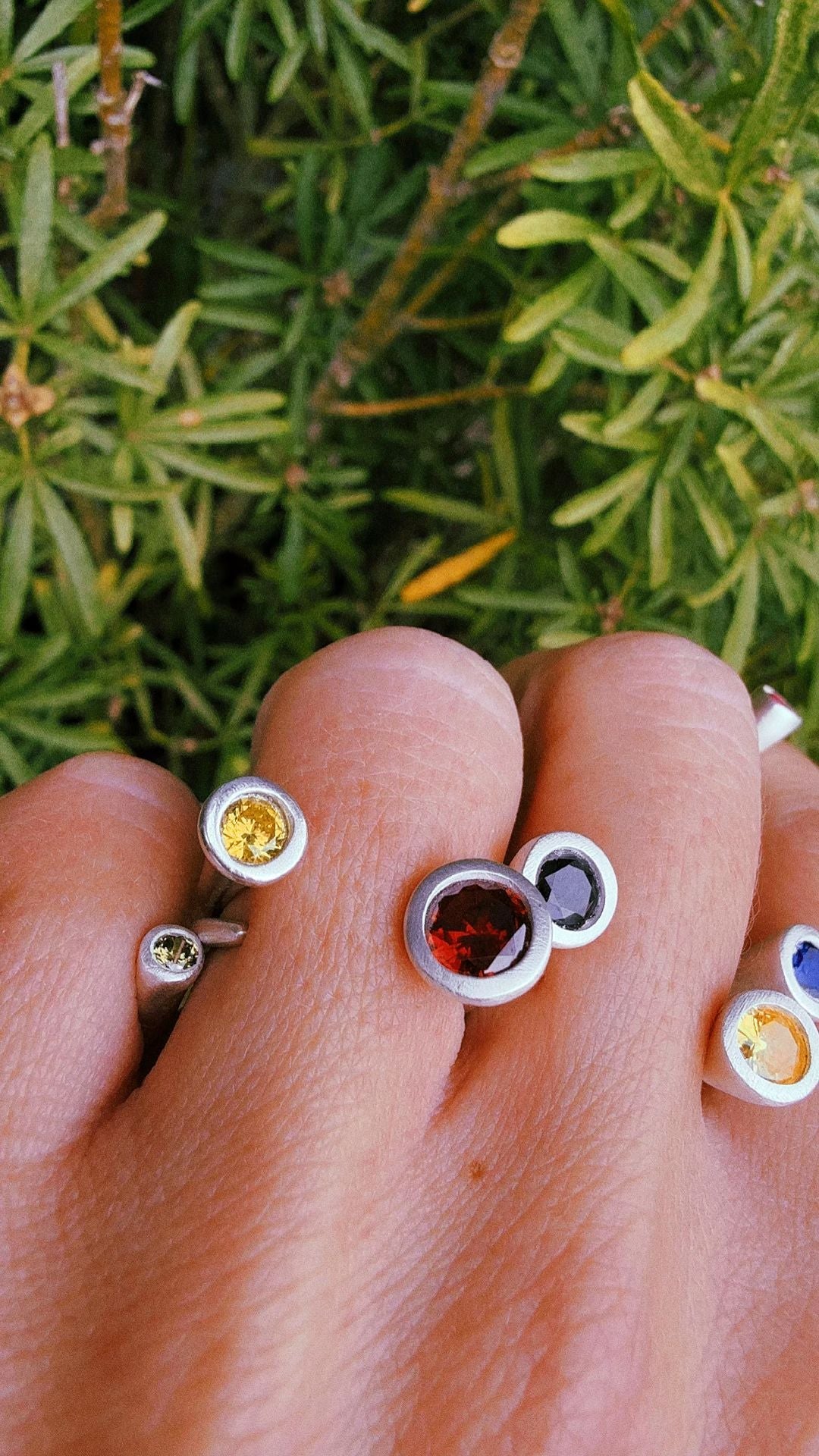
The ring finger gets all the attention, but it is only one of ten choices, and most of the rules people repeat are custom rather than law. If you have just made a ring, or you are about to, it helps to know what each finger traditionally signals so you can choose on purpose.
Why the ring finger became the ring finger
Wearing a wedding ring on the fourth finger of the left hand comes from an old belief that a vein ran from that finger straight to the heart, the vena amoris. Anatomy does not support it, but the custom stuck across much of Europe and the English-speaking world. In Germany, Norway, Poland, Russia and India, among others, the wedding ring sits on the right hand instead. Neither is more correct.
What each finger traditionally means
Thumb. Independence and confidence. A thumb ring is usually wider and plainer than the rest, and it reads as a style choice rather than a statement about a relationship.
Index finger. Historically the home of signet and family rings, because it was the finger you pointed with and therefore the one people saw. It still suits a bolder design.
Middle finger. The most neutral of the lot. No strong tradition attached, plenty of room, and a good home for a first handmade ring you are proud of but do not want to explain.
Ring finger. Engagement and marriage in most Western countries, and on the right hand in many others. Promise rings and memorial rings are often worn here too.
Little finger. Pinky rings carry a slightly formal association through signet rings, and in some professions a graduation ring is worn here. Practically, it is where a delicate band looks best.
Several of those have a guide of their own if you want the longer version: what a thumb ring is usually read as, the signet ring that gave the index finger its reputation, and the promise ring, which has no fixed finger at all.
Left hand or right hand
Beyond wedding customs, the sensible rule is dominance. If you write with your right hand, rings on that hand take more knocks against keyboards, door handles and shopping bags. A ring with a raised stone or a fine, textured surface will keep its detail longer on your non-dominant hand.
Getting the size right before you make one
Finger size is not fixed. Fingers swell in heat and after salty food, and are at their smallest first thing in the morning, so measure in the late afternoon at normal room temperature. Your dominant hand is usually a fraction larger, and the same person can easily be two sizes apart between the index and the little finger.
If you do not know the size yet, measuring with a strip of paper or string is accurate enough to work from, and worth doing at the end of a normal day rather than first thing. A band that turns out slightly wrong is not wasted either: resizing a ring explains what can and cannot be adjusted afterwards.
This matters more when you make your own. Silver clay shrinks by roughly 8 to 10 per cent as it fires, so a ring is built oversized and comes out of the flame at the size you actually wanted. If you are working from our guide to making a silver clay ring, build on a mandrel two to three sizes above your target and let the shrinkage do the rest.
Choose the finger first, then design
It is worth deciding the finger before you shape anything. A band for the index finger can carry a flat face and a set stone; the same design crowds a little finger. A pinky ring wants to stay narrow. A thumb ring can take width but rarely height, since it sits against the palm of the other hand all day.
Whatever you build, it fires to 99.9 per cent fine silver and takes a set stone as readily as a plain polish. The silver clay starter kit includes clay, a torch, tools, a cubic zirconia and instructions, which is enough for a first ring on whichever finger you have settled on. We ship worldwide and cover the duties.
There is no wrong finger. There is only the one you thought about.
Rings are only one part of the vocabulary, and the rest is worth knowing if you are planning a set rather than a single piece — our guide to the types of earrings works as a plain-English glossary of jewellery styles and the fittings that go with them.