

A silver signet ring is the one style almost everyone recognises: a broad band that widens into a flat face on top, ready to carry an initial, a small symbol, or nothing at all. Traditionally that face was carved into solid metal by a goldsmith, which is why signet rings have always been an expensive thing to have made. With silver clay you can make a silver signet ring at your own table, because the flat face that defines the style is also the easiest shape to work while the clay is still soft.
What actually makes a ring a signet ring
Two features. First, a band that tapers: narrow underneath the finger, widening as it rises towards the top. Second, a flat or gently domed face large enough to read at arm's length. Everything else is preference. Faces can be round, oval, square or cushion-shaped, and they can be left plain and polished, stamped with a letter, or textured.
Size the ring before you shape it
This is the step people skip and regret. Silver clay shrinks by roughly 8-10% as it fires, so a band built to your exact finger size will come out of the flame too small to wear. Build the ring one to two sizes larger than you need and let the shrinkage bring it back. Wrapping the clay around a ring mandrel marked a couple of sizes up is the simplest way to keep that consistent.
A signet ring is less forgiving than a plain band here, because you cannot quietly file it larger afterwards without thinning the shoulders. It is worth measuring twice. If you have not made a band before, the step-by-step silver clay ring tutorial covers the basic band technique that the signet builds on.
Building the band and the face
Roll the clay to an even thickness and cut a strip for the band, slightly wider at one end than the other. Wrap it around the mandrel, join the ends with a little paste, and smooth the seam while everything is still damp. Then cut the face separately, as a disc or a rounded square, and set it on top of the widest part of the band.
Two things matter at the join. The face needs a decent thickness so it survives stamping and polishing without flexing, and it needs to be properly bonded, so score both surfaces lightly, wet them and press them together with paste. A signet ring lives on a hand that opens doors and carries shopping, so the join between face and band is the part that has to be right.
Marking the face
Historically a signet was engraved in reverse so it could seal wax. Most people today simply want the mark the right way round. The easiest approach is to press a letter stamp into the clay while it is still soft, working on a firm surface and pressing straight down rather than rocking. A shallow, even impression reads better after polishing than a deep, tilted one.
You can also leave the face plain. A polished blank signet catches light beautifully, and it keeps the option open to have it engraved properly later. If you would rather add a stone than a letter, a small cubic zirconia can be set into the face before firing, since it is designed to survive the flame.
Drying and firing
Let the ring dry completely before it goes anywhere near heat. A signet has thicker sections than a plain band, and trapped moisture is the usual cause of a piece that cracks or blisters. Once it is bone dry, refine the shape with a fine file or sanding pad, because it is far easier to correct now than after firing.
Silver clay is torch-firable, so a handheld butane torch is enough. The binder burns away and what remains is 99.9% fine silver. Keep the ring moving under the flame rather than holding it in one spot, and give the thicker face the same attention as the band.
Finishing the face
Straight from the flame the silver is white and matt. Brushing it with a stainless steel brush brings up a soft satin sheen, and burnishing the raised areas gives the contrast that makes a stamped letter readable. On a signet the usual choice is a bright, mirror-like face against a slightly softer band, which is what makes the shape read from a distance.
What you need to start
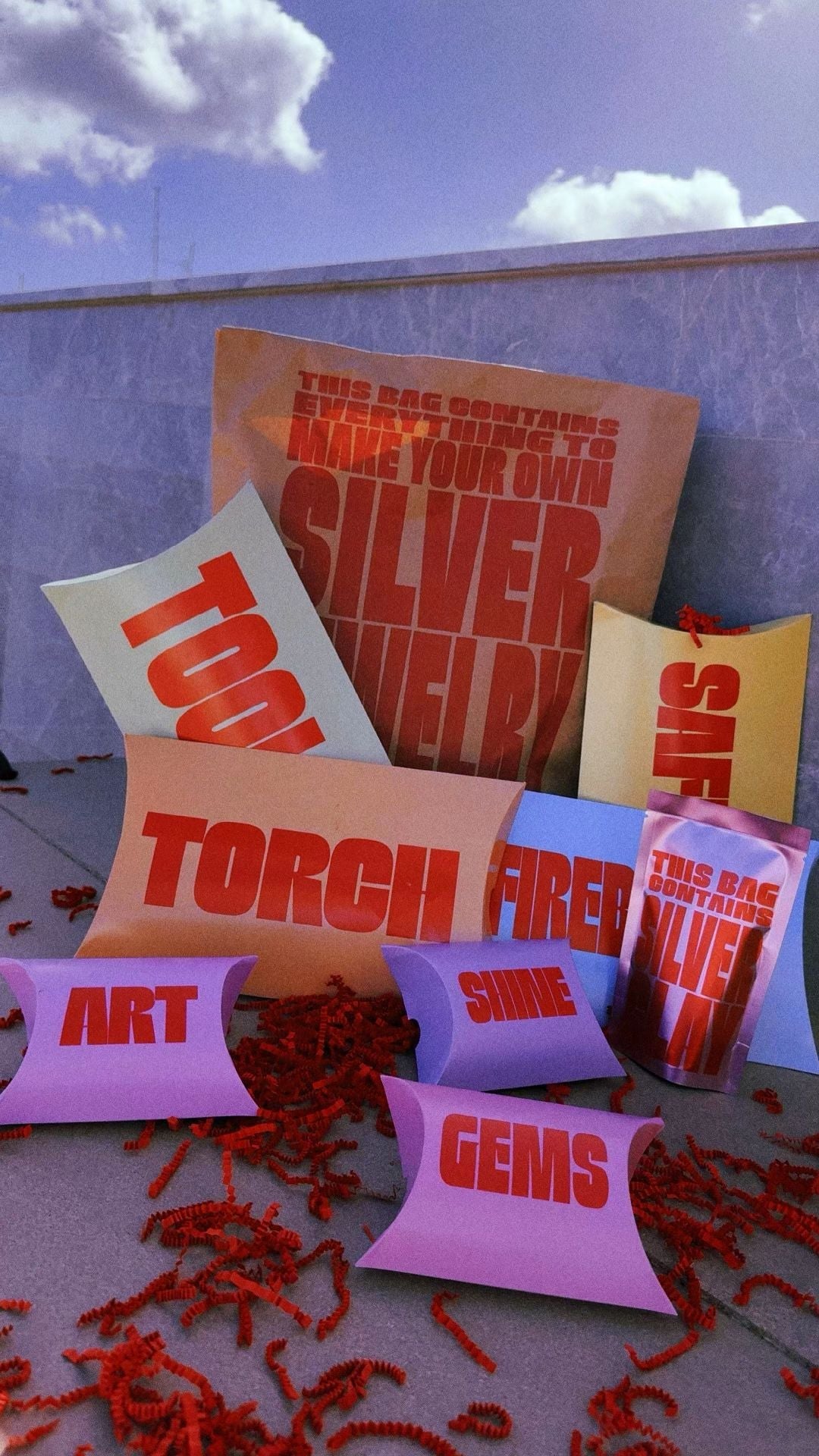
A signet ring needs no specialist workshop: clay, something to shape it round, a torch, and a brush for finishing. The silver clay starter kit brings together the clay, torch, tools, a cubic zirconia and instructions in one box, and ships worldwide with duties covered. If you want the wider background on how the material behaves before you begin, the complete silver clay guide is the place to start.
The appeal of making your own is not that it is cheaper than a jeweller, though it usually is. It is that a signet ring is meant to be personal, and there is a real difference between a letter someone else chose for you and one you pressed into the metal yourself.