

Silver clay shrinkage is the one piece of arithmetic you cannot ignore in metal clay. When you fire the clay, the organic binder burns away and the silver particles fuse together, and the piece comes out of the flame roughly 8 to 10% smaller than it went in. Nothing has gone wrong. It is how the material works, and once you expect it, it stops being a problem and becomes a tool.
What silver clay shrinkage actually does to your piece
Shrinkage is proportional, not uniform in effect. Every dimension pulls in by the same percentage, which means the change you notice depends on which dimension you cared about.
On a flat pendant, 8 to 10% off the width and height is barely visible. Nobody looks at a finished piece and thinks it should have been a millimetre wider. On a ring band, the same percentage is the difference between a ring that fits and a ring that will not go past the knuckle. On a hole drilled for a jump ring, it can be the difference between threading easily and not threading at all.
There is a pleasant side effect too. Because everything contracts, surface detail gets slightly tighter and crisper. A texture that looked a little soft in the raw clay often reads better after firing.
Rings: where shrinkage matters most
A ring is the only common metal clay project where getting the size wrong ruins the piece. The band has to end up at a specific internal diameter, and you are building it at a larger one.
The practical approach is to build the ring on a mandrel a couple of sizes above the size you want, then check the fit after firing. Two sizes up is a reasonable starting point for most clays, but the honest answer is that you should test it once with your own clay and note the result. Every maker ends up with their own number, and that number is worth more than any general rule.
Wide bands need a little more allowance than narrow ones, because a wide band has to pass over the knuckle across more of the finger. If you are making a broad band, go up slightly further than you would for a thin one.
Stones, settings and holes
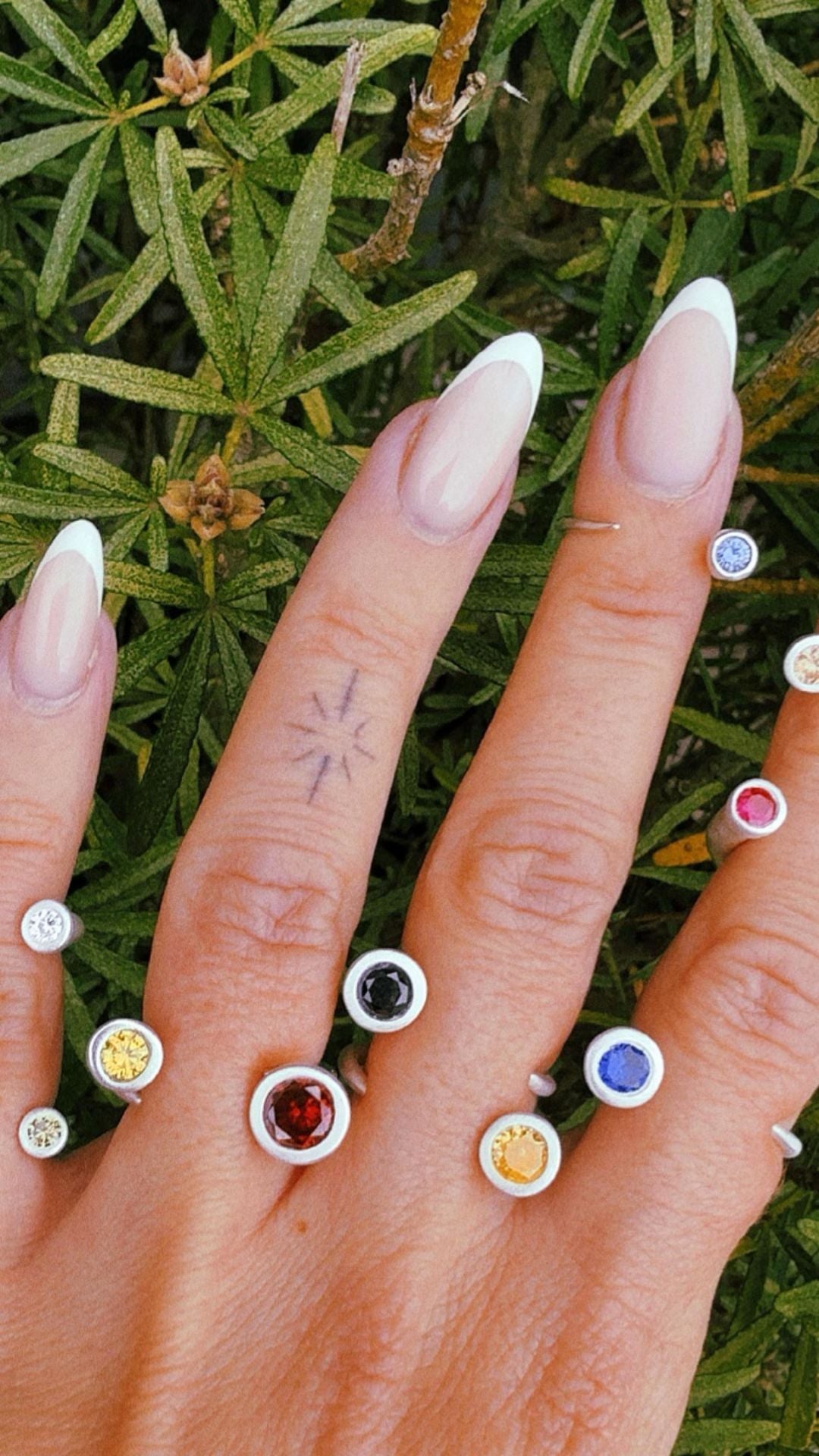
This is where shrinkage catches people out most often. A setting made to fit a stone snugly in the raw clay will grip that stone too tightly once fired, and the pressure can crack the stone or distort the bezel.
Set the stone in the wet clay rather than trying to fit it afterwards, and let the shrinkage do the gripping for you. That is precisely how a fired setting holds a stone without prongs. Lab-created stones such as cubic zirconia are made to survive the firing temperature, which is why they are the usual choice for torch-fired work.
For holes, the rule is simple: drill them larger than you need. Measure the jump ring or chain, then make the hole comfortably wider. You can always file a hole slightly bigger after firing, but it is fiddly work on a small piece and easy to slip.
Joining pieces and why cracks appear
If a piece is made of parts joined together, all of those parts need to shrink at the same rate. That is straightforward if everything is the same clay and the same dryness, and much less straightforward if you attach a wet element to a bone-dry one. The wet part shrinks more as it dries and again as it fires, and the join takes the strain.
Let components reach a similar dryness before joining them, use paste generously at the seam, and dry the assembled piece fully before firing. Most shrinkage cracks are really joining cracks wearing a disguise.
Use it deliberately
Once you trust the number, shrinkage becomes useful. It tightens settings around stones without any extra work. It sharpens texture. It lets you work at a slightly larger, more comfortable scale and end up with a piece that reads as delicate. Makers who fight it produce inconsistent work. Makers who plan for it get the same result every time.
The finished metal is 99.9% fine silver either way. Shrinkage does not change what the piece is made of, only how big it ends up.
Putting it into practice
The fastest way to learn your own shrinkage figure is to make a ring and measure it. How to make a silver clay ring walks through the process, and the complete guide covers drying, firing and finishing in more depth. If you are starting from scratch, the silver clay starter kit has clay, a torch, tools, a cubic zirconia and instructions, and ships worldwide with duties covered.