

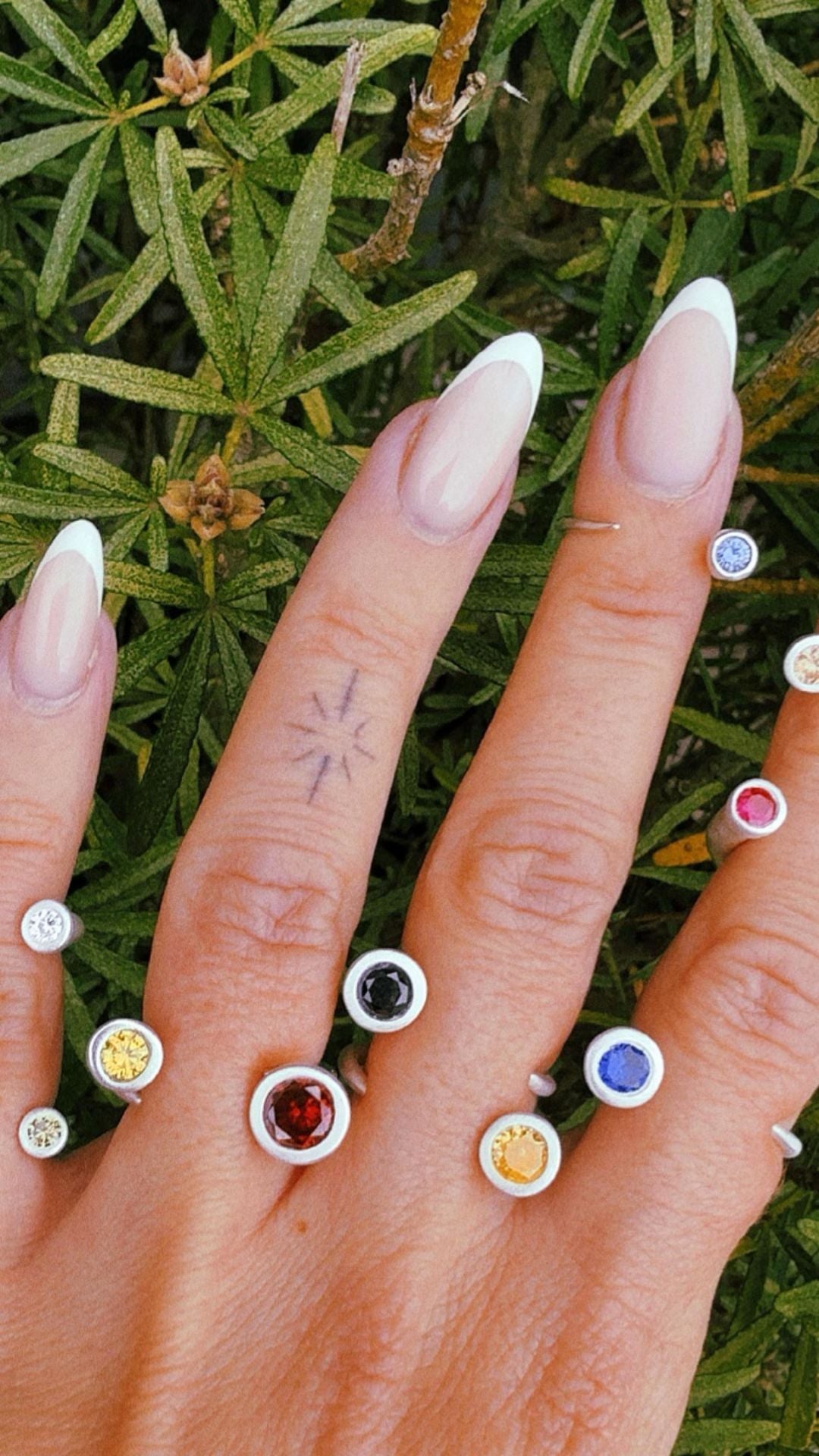
A cabochon is a stone that has been shaped and polished into a smooth dome with a flat back, rather than cut into facets. If you have ever seen a moonstone ring with a soft glow instead of a sparkle, or a turquoise pendant with a rounded top, you have seen a cabochon. For anyone making jewellery at home, it is the friendliest stone there is: no fragile points, a flat back that sits neatly against metal, and no need for a jeweller's bench to hold it in place.
What is a cabochon, exactly?
The word comes from the French caboche, meaning head or knob, and it describes the cut rather than the stone. Almost any material can be cut as a cabochon: agate, moonstone, labradorite, turquoise, lapis, opal, or plain glass. Faceted cuts use flat planes to bounce light back at you, which is why diamonds and cubic zirconias flash. A cabochon does the opposite. It shows off colour, pattern and the way light moves inside the stone.
Most cabochons are oval or round, though squares, teardrops and freeform shapes are common too. Standard sizes are quoted in millimetres, so a 10x8mm oval is ten millimetres long and eight wide. Buying a standard size makes life much easier later, because you can plan your setting around a shape you can replace if something goes wrong.
Why cabochons suit handmade silver
A faceted stone has a pointed underside, so it needs a seat cut into the metal and a setting that grips it from several angles. A cabochon has a flat base. It only needs something to sit on and something to hold it down at the edges, which is a far simpler thing to build.
That difference matters enormously when you are working with silver clay, because you can shape the setting by hand while the clay is still soft. There is no sawing, no soldering and no filing a seat. You press, smooth and check the fit, and when the piece is fired it becomes 99.9% fine silver with the setting already built in.
Our complete guide to silver clay walks through how the material behaves from soft putty to solid metal.
Can you fire a cabochon in place?
This is the question that decides your whole design, and the honest answer is: it depends entirely on the stone.
Lab-created stones such as cubic zirconia are made to withstand heat and are routinely fired in place, which is why they are included in the silver clay starter kit. You set them into the wet clay, fire the piece with a torch, and the stone comes out held by the silver that shrank around it.
Most natural cabochons are a different matter. Opal, turquoise, moonstone, amber and anything with water or organic material in it can crack, cloud or discolour when heated. Unless a supplier states plainly that a stone is safe to fire, assume it is not, and plan to set it afterwards. Losing a stone you liked is a slow way to learn this.
How to set a cabochon after firing
The usual approach is a bezel: a thin wall of silver that runs around the edge of the stone and is pushed inwards to hold it. With silver clay you build that wall before firing, leaving it slightly taller than the dome of the stone and remembering that the piece will shrink by roughly 8-10% as it fires. Plan the opening a little generously and test-fit as you go.
Once the piece is fired and brushed up, the stone drops in and the top edge of the bezel is eased over with a burnisher, working in small steps around the circle rather than pressing one side flat. A drop of jeweller's adhesive under a stone with a very flat back adds security without showing.
Choosing your first cabochon
Start small and start opaque. A 10x8mm agate or jasper oval costs very little, has a predictable flat back, and forgives an imperfect bezel far better than a translucent stone does, where any gap shows as a shadow. Buy two of the same size so you have a spare to check the fit against while you work.
Once you have set one successfully, the technique carries across everything: rings, pendants, earrings, cufflinks. The stone changes, but the method stays the same.