
Once you have made your first ring, the obvious question is what to make next. Good silver clay ideas are rarely about complicated technique. They are about choosing a project that suits the small amount of clay in front of you and the few minutes a torch firing actually takes. Here are ten that work well as a second, third or tenth piece.
Silver clay ideas that use texture
1. A textured disc pendant. Press linen, lace, coarse watercolour paper or a leaf into rolled clay, cut a circle, and make a hole for a jump ring before it dries. The texture does all the design work for you.
2. A pair of mismatched earrings. Two small shapes with the same texture but different outlines. Deliberately mismatched pairs are far more forgiving than trying to make two identical pieces.
3. A botanical impression. A single real leaf or fern pressed hard into thick clay gives a piece with genuine depth once you polish the raised veins and leave the recesses dark.
Texture sheets make any of these repeatable, and hand stamping is the same idea with letters.
Ideas that hold a stone
4. A stone-set pendant. A cubic zirconia pressed into soft clay and fired in place is the single most impressive thing a beginner can do, and it takes no extra tools.
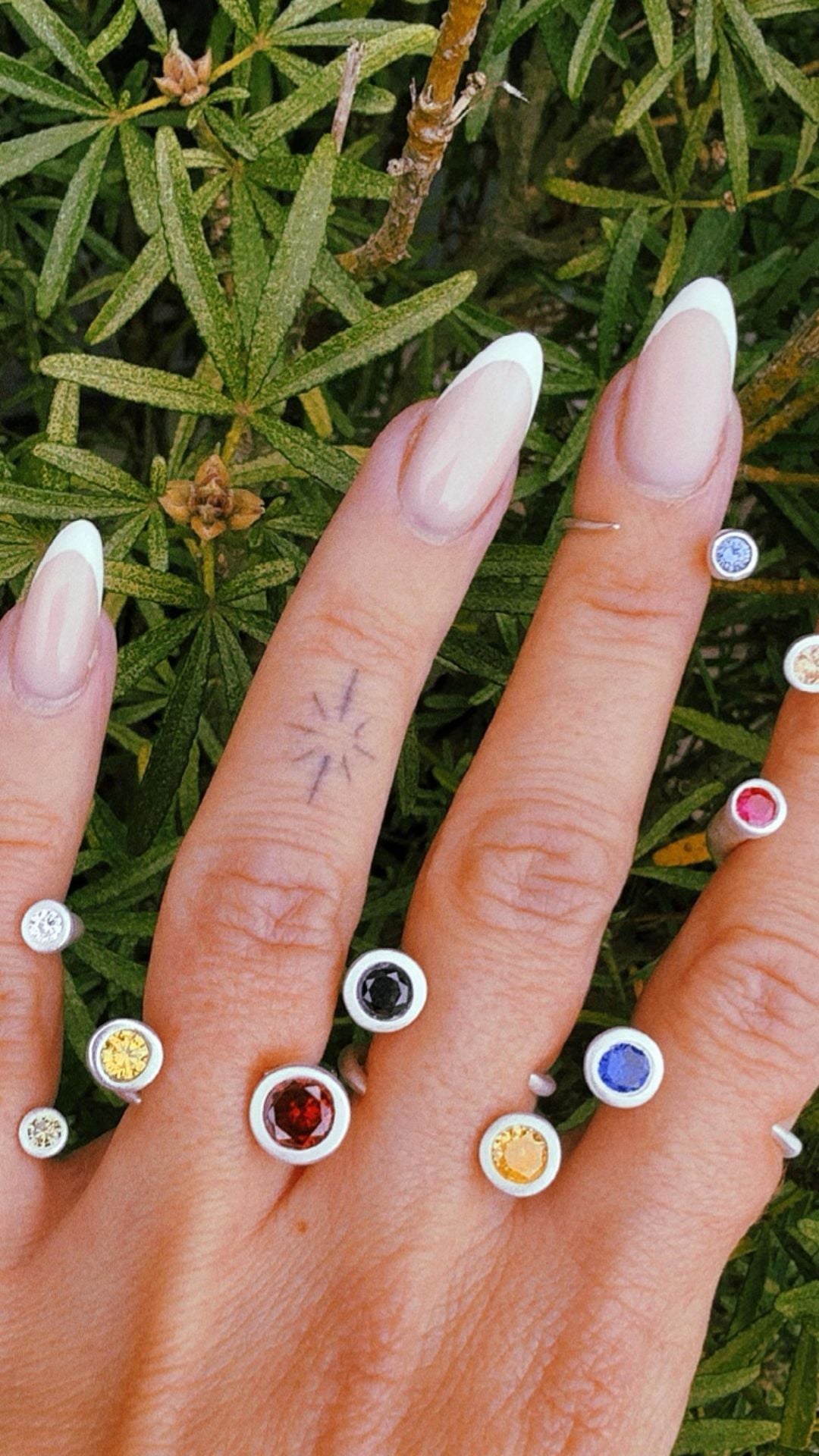
5. A stacking ring with one small stone. Narrow, plain, one point of sparkle. Made in threes these look intentional rather than repetitive.
Cubic zirconia is the stone to use here, because it survives the flame. Setting gemstones in silver clay covers the ones that have to go in cold, and cabochons are the flat-backed shape that suits a bezel.
Ideas that carry meaning
6. An initial charm. Cut or stamp a single letter, keep it chunky enough to survive filing, and hang it from a chain.
7. A date or short word. Letter stamps pressed into a small bar make a keepsake that means something to one person in particular.
8. A fingerprint keepsake. Press a fingerprint into thick clay and fire it. It is a surprisingly moving object once it is real silver.
That last one has a whole family behind it. Keepsake jewelry covers the impressions that work — fingerprints, handwriting, a paw print — and the limit that catches people out: anything organic burns away in the flame, so hair and ashes have to be added to the finished silver rather than fired into it. A fingerprint necklace is the usual first attempt.
Ideas that use very little clay
9. Small beads. Roll tiny shapes around a cocktail stick to leave a hole, dry, then fire. They add up into something over several sessions.
10. A pendant bail. A small silver loop or decorative bail to hang a stone or an existing pendant from. It uses almost nothing and improves a piece you already own.
Necklace bails and jump rings are the two findings most worth making yourself; findings for silver clay covers the rest.
Small pieces are also the cheapest way to learn, because what a project costs follows how much clay goes into it, and what silver clay costs works the sum out per piece rather than per packet.
What all of these have in common
Every project on this list fires with a torch, comes out as 99.9% fine silver, and shrinks by roughly 8-10% along the way. Plan for that shrinkage on anything that has to fit a finger or take a jump ring, and the rest is just shaping.
If any step is still unclear, the complete silver clay guide covers the whole process from rolling to polishing, and the silver clay ring tutorial is the natural warm-up for most of these projects.
You do not need a new tool for any of them. The silver clay starter kit already contains the clay, torch, tools, a cubic zirconia and instructions, and refills of silver clay are what you buy once you get going. We ship worldwide with duties covered.
If you would rather pick by form than by technique, the glossary guides are the place to browse: types of earrings, types of bracelets and necklace chain types. The silver clay versions have tutorials of their own: earrings, charms, a bracelet and a pendant.
Why these ideas only work in silver
Every project above fires with a torch at a kitchen table, and that is a fact about the metal rather than about the project. Silver is the one metal clay that sinters in open air; the rest of the family needs a kiln and a container of activated carbon. Bronze, copper and brass all fire that way, and steel clay asks for more patience still.
So if one of these ideas appeals, you can start it this afternoon. Swap the material and the same list of projects turns into a kit list and a firing schedule instead. The other metals are worth reading about for their colour, but the ones carrying copper tarnish rather than staying bright, which suits some designs beautifully and rules out others.
Pick one, make it badly, then make it again. That second attempt is usually the one you end up wearing.