

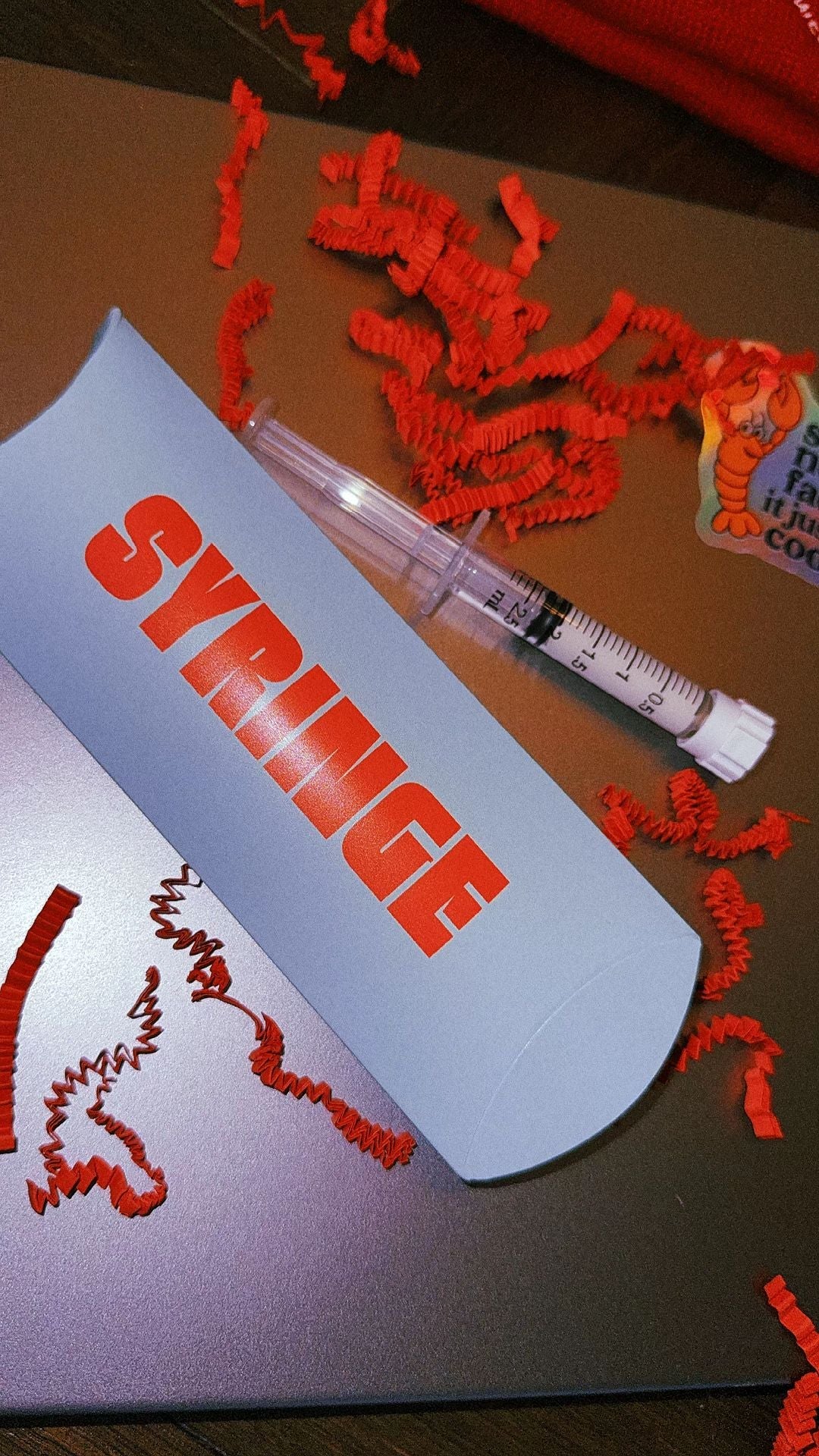
A silver clay syringe does one thing that no other tool in metal clay can: it lets you draw. Where rolled clay gives you flat shapes and carved detail, the syringe extrudes a continuous, even thread of clay that you can lay down in loops, lettering, filigree and lace. It takes a little practice, and then it opens up a whole category of work.
What a silver clay syringe is
The syringe is simply silver clay mixed to a softer, more fluid consistency and loaded into a barrel with a fine tip. Squeeze the plunger and a thin round thread comes out. It is the same material as the clay you roll by hand — after firing it becomes 99.9% fine silver and shrinks by the same 8-10%, so syringe work sits happily alongside rolled and carved elements in one piece.
Tips come in different diameters. A finer tip gives delicate, lace-like lines; a wider one gives a bolder, rope-like thread. If you only have one, a medium tip will handle most beginner projects.
Holding it and laying the line
This is where most people go wrong at first, and the fix is counter-intuitive: do not drag the tip along the surface. Instead, hold the syringe roughly 1-2 cm above your work, squeeze steadily, and let the thread fall onto the surface while you move the syringe along. Gravity does the placing. Dragging the tip flattens the line and makes it wobble.
A few things that make an immediate difference:
- Use both hands — one on the plunger, one steadying the barrel.
- Squeeze at a constant rate. Uneven pressure gives you a line that swells and thins.
- Move at a steady speed. Too slow and the thread coils on itself; too fast and it stretches and breaks.
- Practise on a scrap tile before touching the real piece. Ten minutes of practice saves a ruined project.
To finish a line cleanly, stop squeezing a moment before you reach the end point, then lift away. The thread already in the air will complete the stroke.
What to make with a silver clay syringe
Lettering and signatures. Names, initials and dates piped freehand onto a pendant. Sketch the shape lightly into the clay first as a guide.
Filigree and scrollwork. Loops and spirals built up on a flat backing, or piped over a former to create openwork with nothing behind it.
Bezels for stones. Pipe a ring of clay around a cubic zirconia to hold it in place. This is one of the most practical uses — it gives a secure, decorative setting in a single step.
Decorative edges. A piped border around the rim of a pendant or a ring band adds definition and hides a slightly uneven edge.
Repairs and reinforcement. A bead of syringe clay along a weak join adds strength where a piece will take stress.
Keeping the syringe working
A blocked tip is the most common frustration, and it is almost always dried clay. Whenever you put the syringe down — even for a minute — rest the tip in a small pot of water or under a damp sponge. If it does block, soak the tip in water until the clay softens, then clear it gently. Never force the plunger against a blockage.
Store the syringe tip-down in water or wrapped in a damp cloth inside an airtight container. Between sessions, check the plunger still moves freely before you start work rather than discovering it does not mid-line.
Drying and firing syringe work
Piped lines are thin, so they dry fast — often within minutes. Handle dried syringe work carefully, because fine threads are fragile before firing. Support delicate openwork on a bed of vermiculite or fibre blanket while it dries so it does not sag.
Fine lines fire readily and can be torch-fired like the rest of your clay, but they also reach temperature quickly, so keep the flame moving and watch the piece rather than the clock. Very fine filigree is easy to overheat.
Once fired, brush the piece up and the piped lines take a shine that catches light beautifully against a matte background — one of the reasons syringe work looks so much more elaborate than the effort it actually takes.
You will find silver clay in the silver clay range, and the starter kit brings together clay, torch, tools, a cubic zirconia and instructions if you are beginning from scratch. New to the material? Start with how to use silver clay and get comfortable with the basics before you pick up a syringe.