


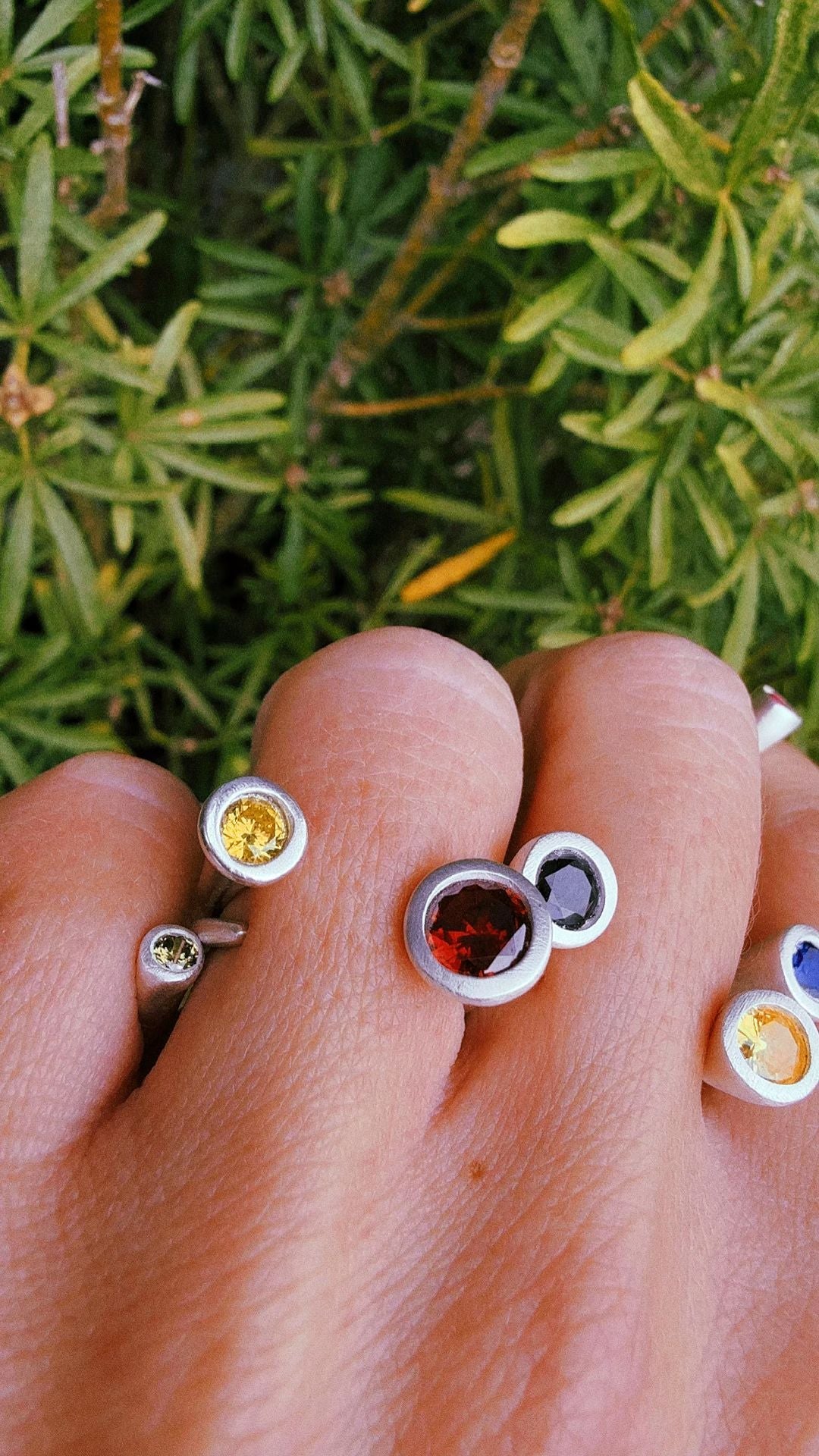
This green-stone silver ring was made at home, from clay that turns into real silver. 1.3 million people watched it happen — here's the reel, and how you can make your own version this weekend.
What you're seeing
The band is rolled from silver clay, the green cubic zirconia is pressed straight into the wet clay, and after drying the whole ring is torch-fired. The binder burns away, the silver particles fuse, and the stone is locked in place permanently — a real 99.9% fine silver ring with a set stone, no prongs or glue.
How the stone stays in
The grip comes from the shrinkage rather than from any clever setting. Firing burns the binder away, the silver particles sinter, and the piece comes out 8–10% smaller than it went in. The stone does not shrink. The clay closes in around it instead, by a fraction of a millimeter, so a stone merely resting in a hollow beforehand is gripped afterwards. That makes the seat the thing that matters most: push the stone in until the clay edge sits slightly above its widest point, all the way round. Below that line the shrinkage pushes the stone back out; bury it too deep and you lose the sparkle you set it for. The full guide to setting gemstones in silver clay works through the seat in detail, and silver clay shrinkage explains where the figure comes from.
The dependable list of stones that survive the flame is short: cubic zirconia, and lab-created corundum and spinel. All three are grown rather than mined, so there is no trapped water and no inclusion to expand and fracture. Cubic zirconia sits at around 8 to 8.5 on the Mohs hardness scale, hard enough for everyday wear, and it is the stone most people should start with. Everything else — natural stones, pearls, anything organic — is set cold, after firing, into a piece that is already silver. For a first attempt, 2–4 mm stones are much easier to seat than large ones.
Choose your stone, choose your story
Green for a birthstone, clear for a classic, pink for the friend who loves pink — fire-safe cubic zirconia comes in every color. Browse the gem collection, or use the stones included in the kit.
Sizing the band before it shrinks
A ring is the one common silver clay project where the arithmetic can spoil the piece: the band you shape is not the band you wear. Measure the finger first — measuring a ring size with string needs nothing you do not already own — then form the band oversized on a ring mandrel and let the shrinkage bring it back down. Rather than trusting a general rule, fire one test band from an offcut and measure where it sits on the mandrel afterwards: that gap is your own allowance, and it holds for every ring you make with the same clay. A band wider than roughly 6 mm wants a size more, because it has to pass over the knuckle across more of the finger.
Allow about 6–9 g of clay for a plain band in a common size, or 4–5 g for something slim. Wrap the mandrel in baking paper or a sticky note before the clay goes on, so the dried band slides off without a fight. The step-by-step version of the whole process is in the beginner walkthrough for using silver clay.
Firing it with a torch
Silver is the one metal clay you can fire in open air with a handheld torch; the base metal clays need a kiln and activated carbon. Fine silver melts at 961°C and sintering happens comfortably below that, which is why a torch firing is judged by color rather than by a number — silver clay firing temperature sets out what to look for, and the torch firing walkthrough covers the setup, the timing and the quench. The band has to be completely dry before it meets the flame: any moisture left in the clay turns to steam and cracks the piece.
Finishing, and what to expect afterwards
What comes out of the flame is 99.9% fine silver, purer than sterling and a little softer, so a ring meant for daily wear is better made slightly thicker. Brush it, sand it through progressively finer grits, and burnish it — a jewelry tumbler both polishes and work-hardens the metal, though it only shines what you have already prepared by hand. That purity is also why fine silver rings keep their brightness: the less copper an alloy contains, the more slowly a tarnish film forms, which is the argument set out in what silver doesn't tarnish.
Variations on the same ring
The method does not change when the stone does. Choose the color for the month it stands for and the result is a birthstone ring; make three slim bands instead of one wide one and you have a set of silver stacking rings, which is a good use for the clay left over.
Make yours this weekend
The Silver Clay Starter Kit has the clay, torch, tools and stones. Step-by-step help: the silver clay ring tutorial and the complete silver clay guide.